

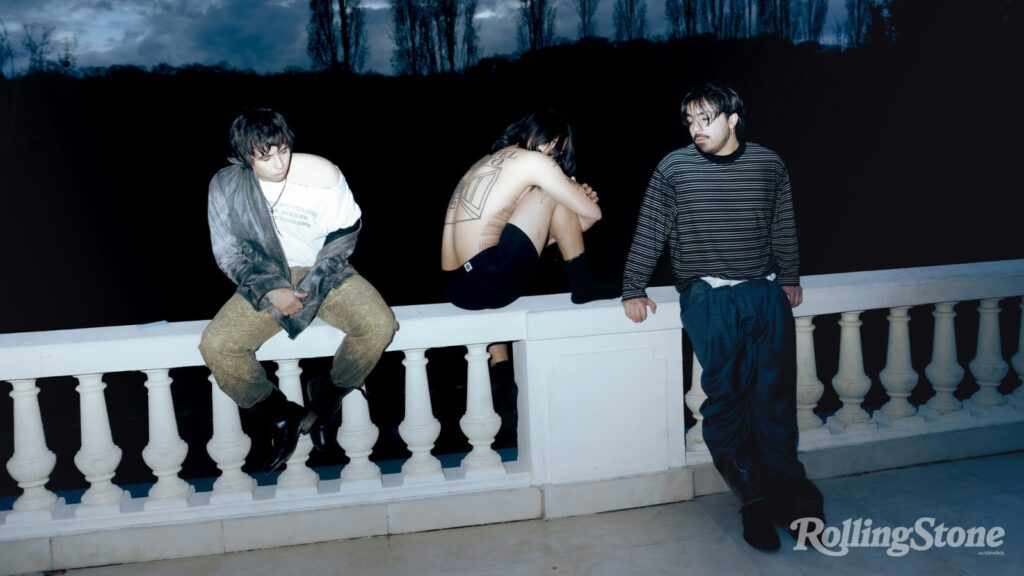
Latin Mafia Made It to the Top By Feeling It All
The Evolution of Latin Mafia
Before our interview begins, Milton de la Rosa — one of the vocalists in the Mexican band Latin Mafia — is busy playing the harmonica. “It’s crazy. It’s relatively simple until it isn’t. Playing clean notes is hard. We’re working on that right now,” he says as his twin brother Emilio and his older brother Mike arrive.
Latin Mafia, made up of the trio of brothers, just arrived from a trip to Paris, capping off an intense year that shot them to the top of the Latin music scene. During a rare break, they speak with Rolling Stone en Español about their latest project — and how they’re working on their mental health, learning new things, reflecting on success, and taking their career to the next level.
The guys have known how to step out of their comfort zone and evolve when necessary, breaking rules, and understanding that music is felt deeply. With that approach, they have connected with an increasingly large audience, going from 200-person crowds to 200,000-capacity venues.
A Foundation of Closeness
Clearly, their closeness as brothers came long before they became a band. They shared bunk beds since they were little — the kind with a mattress that slides out from the bottom. “We’ve always been very close. We played football, went to music lessons together. We’ve always been a very close-knit family. We slept in one room, in a three-tier bunk bed,” Emilio says.
“Even after we’d been able to make a living from music for quite some time, when things were going relatively well for us, we still lived at our parents’ house… Closeness isn’t something new for us; it’s something we’re very, very used to,” Milton adds. “I think that’s been pretty key to our dynamic as a project, not just as brothers or as friends. There’s no filter when we say, ‘No, for real, that’s terrible, that sounds wrong, we have to do something else.’ We really don’t hold back among ourselves.”
The Creative Process and Digital Growth
Since early on, music was a natural part of their daily lives. “It’s always been there; now we just had to understand it a little better,” Milton explains. Their approach began with exploration: “When we were kids, we unconsciously were like, ‘Oh, well, I’m just going to hang out with my friends and discover things,’” Mike recalls. “We’re really grateful to our parents because they always got us into that kind of thing… It was a lot of fun, but also very recreational — it was all about exploring and figuring out what we liked.”
Like a lot of artists in the digital age, the Mexican brothers gained attention through TikTok, but the platform didn’t just give them an audience — it allowed them to shape their style through experimentation and a consistent routine of creating music videos. “I think we were lucky we didn’t have to release all that crappy music you put out before the good stuff,” says Emilio. “I feel like it’s something we’ve always had as a motto: ‘Make a thousand songs and release the thousand-and-first.’ It was a process where we could practice making music every day, all day long, and also build anticipation among people while we were doing it. By the time we felt ready to release something, it was what we felt was truly worth it,” Mike adds.
Reflecting on ‘TODOS LOS DÍAS TODO EL DÍA’
Today, the trio is in a new creative phase that emerged after their debut album, TODOS LOS DÍAS TODO EL DÍA. Those songs, they say, will always hold a special place in their hearts. “I have a deep appreciation for them, because it’s thanks to those songs that we were able to make the album. For that simple fact, I’m extremely grateful and appreciate them so much,” Mike says.
Emilio adds: “It’s a part of us that will always be there. We’ve always said that the album was the first time we sat down and said, ‘This is what we want to do.’ Before that, we did think about audiences, going viral, and finding a favorable situation to be able to explore.”
“We feel more connected to and identify more with the period following the album’s release, but we don’t hate anything we did before. I think it was a wonderful phase that was definitely necessary,” Milton says. “We strongly believe that not everything has to be too intense, not everything has to carry too much weight,” he adds. “We were much younger, experimenting, listening to new sounds, and discovering new things.”
Prioritizing Mental Health and Future Projects
After an intense year, taking a break meant starting to look inward and asking questions that don’t usually come up when everything is moving so fast. “I was talking to a psychologist because right now I’m seeing three psychologists and a psychiatrist. I said: ‘We’re going to tackle this from every angle.’ I’m bombing the anxiety and depression,” Milton confesses.
The brothers are living the life they always imagined. They’re achieving their goals, traveling the world, financially secure, and collaborating with artists they admire — yet, at the same time, they can be overcome by deep sadness that stems from anxiety and depression. “It’s really hard to think that you cannot see that from the outside,” Milton muses. “I feel like life has given us so many blessings that there are times when you can feel like you’re being ungrateful.”
Looking ahead, the band is focused on new music, audiovisual content, and publishing projects. They confirmed that a documentary is in the works and a photo book is forthcoming. “We’re first and foremost fixing our mental health,” Milton says with a laugh. “We’re having new experiences, meeting friends and people, experiencing new things, so we can finish what we’re doing. So yeah, we’re inspired, we’re very happy.”