
Charlie Kirk’s Afterlife as AI Slop Is No Accident
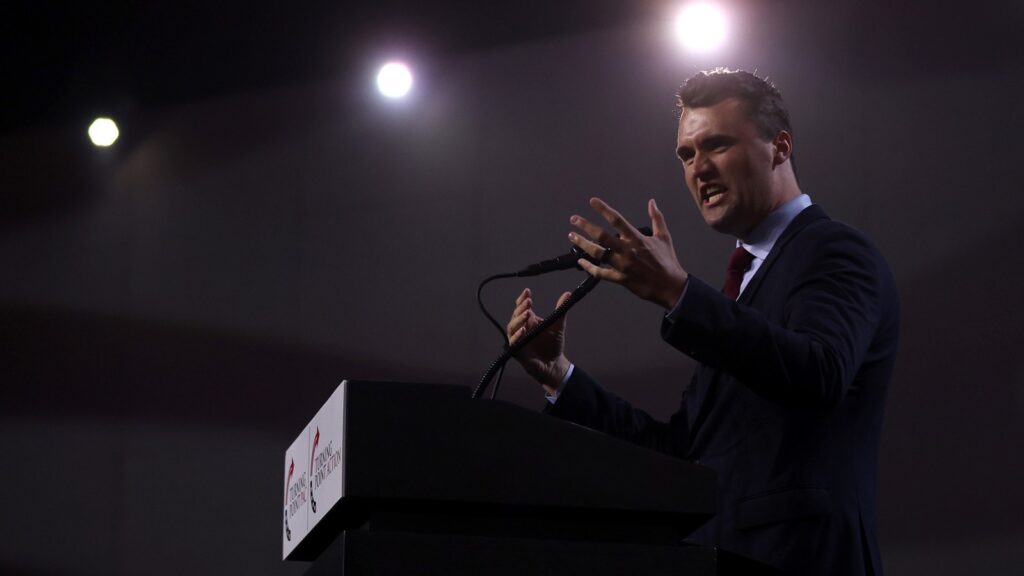
The shocking assassination of right-wing activist Charlie Kirk on a Utah university campus in September sparked a firestorm of extreme rhetoric and recriminations. Democrats and Republicans accused one another of fostering a culture of violence; partisan commentators grasped for any indication that 22-year-old Tyler Robinson, the young man eventually arrested and charged with Kirk’s murder, was motivated by the ideology of their personal political enemies. There were mournful tributes, too, but they went largely unnoticed amid a fierce debate over Kirk’s legacy as his supporters agitated for anyone who criticized the self-styled First Amendment advocate to lose their jobs.
Despite hundreds of Americans being fired or suspended by employers as a result, the pitch-dark humor that permeates our social media ecosystem was not to be suppressed. In the weeks and months after the shooting, Kirk’s name and face became a new type of fixture on the internet, not out of reverence for a slain hero but out of a trollish and enduring contempt. In some respects, the phenomenon echoed the unsympathetic commentary about the murder of UnitedHealthcare CEO Brian Thompson last year (though the executive’s alleged killer, Luigi Mangione, enjoys significantly more public support than Robinson does).
Instead of winding down as most internet trends do, Kirk memes have continued to multiply and mutate, with his likeness inserted into classic reaction images and pasted onto the bodies of countless celebrities — a swapping process that has become known as “Kirkification.” By December, TikTok users were racking up millions of views on AI-generated brain rot videos that depicted Kirk as Captain America in the finale of Avengers: Endgame, teaming up with Jeffrey Epstein and Sean “Diddy” Combs. What could possibly explain it?
In the wake of his death, some felt justified in mocking Kirk because of the racist and sexist politics he relentlessly promoted in life. It probably helped, too, that the Turning Point USA founder had been a subject of taunting memes for years, most of them focused on his appearance. Others seemed to take the MAGA coalition’s crackdown on anti-Kirk commentary — which undermined their whitewashed portrayal of him as a sainted martyr — as an invitation to push the envelope further.
Unable to project solemn grief, conservatives went with spectacle and crass remarks. That tone set the stage for the hecklers. Two days after the world saw Kirk cut down by a single bullet from a sniper, a reporter asked Trump how he was processing the brutal execution of a key surrogate; Trump instead talked about his plans to add a $200 million ballroom to the White House. Later that month, both the president and Kirk’s widow, Erika Kirk, entered his stadium memorial service in Phoenix to showers of fireworks, like professional wrestlers.
Right-wing talking head Candace Owens, a longtime friend of Kirk’s who launched her career at TPUSA, has worked overtime to spread and profit from deranged conspiracy theories about an international plot to eliminate him that supposedly involved the governments of Israel, Egypt, or France. Milo Yiannopoulis, another right-wing commentator, speculated that Kirk was gay, that his body was never buried, and that he could still be alive. A cryptocurrency entrepreneur promoted a meme coin called “Kirkinator” with AI-generated videos of Kirk as a cyborg.
Under the Trump 2.0 regime — in online forums that significantly rolled back moderation — right-wingers have declared that they have carte blanche to dispense with “woke” or “politically correct” discourse, reviving slurs to demonize opponents and cruelly exploiting the assassinations of progressive liberals as they see fit. This same climate, however, allowed for vicious attacks on a provocateur from their side who had just been killed in cold blood. The more they raged at this disrespect shown to a fallen comrade, the more emboldened the haters were, cooking up edits of Kirk as everyone from Michael Jordan to Jonah Hill, Beethoven, and the Mona Lisa.
Earnest attempts to memorialize Kirk, or cynically profit from his demise, fueled the rise of so-called “Kirkslop.” There was the campaign to erect a campus statue of him at the New College of Florida, a proposal that included an AI-generated Kirk cast in bronze, derided as a tacky and unwanted tribute. A couple of social media users apparently sought to deify him in Christlike fashion by applying the inititalism “A.K.” (for “After Kirk”) to the period following his death — but detractors brandished term ironically, turning it against the TPUSA acolytes. Cash-grab products such as a line of Kirk-themed wines from a pro-Trump winery were beyond self-parody.
Then, of course, there was the AI-generated song “We Are Charlie Kirk” by the nonexistent band Spalexma, an anthem so utterly inane yet bombastic in its worship of the deceased podcaster that it was destined to soundtrack thousands of TikToks that weaponized it for highlight reels of Kirkified pictures. It came from a full record titled Charlie Kirk Forever Alive, which hit Spotify eight days after the assassination — Spalexma has released an impressive 18 albums so far in 2025 — and caps off a tracklist that also includes the titles “Voice on Fire,” “I Bore the Cross,” and “A Warrior of Truth.” (A Kirk ode that the fictional group debuted a couple of days earlier, “Welcome Home Charlie,” didn’t gain quite the same traction.) Though it was appreciative Kirk supporters who surfaced Spalexma’s blaring algorithmic oddity, it now unquestionably belongs to the sarcastic left.
It’s clear that Kirk is the first national figure to be fully absorbed into the expanding multiverse of digital slop in large part due to the popularity of this anti-creative aesthetic — and basic indifference to truth or empathy — among his most prominent colleagues. It would have made less sense for those who loathed Kirk and what he stood for to debase him this way if his faction wasn’t so weirdly enamored with the potential to distort reality using deepfakes and crude animations. He belongs to that tradition now, trapped in a netherworld of endlessly recycled references.
Kirk’s allies want him remembered as a champion of young conservatives and open debate. But this heavy tide of content ridiculing any notion of his lasting importance to the American republic suggests a far different fate. As a visual punchline stripped of ideas, he symbolizes only the nihilism of the moment, our ability to turn even the breakdown of civic order into a running joke. The really frightening thing is that these artifacts are manufactured by and for the toxic internet subcultures that Robinson swam in, where political violence is promoted as a means to viral glory, or a justified end in itself.