
Inside ‘Luigi: The Musical’: Satire, Celebrity, and the Media Circus
“You’ve got a lot of fans out there, people are posting, marching in the streets,” the prison security guard tells a young inmate with thick eyebrows, handing him a stack of fan mail. “Apparently, there’s even a musical.”
“What kind of sick fucks would buy tickets to something like that?” the prisoner asks, prompting a round of laughter from the audience.
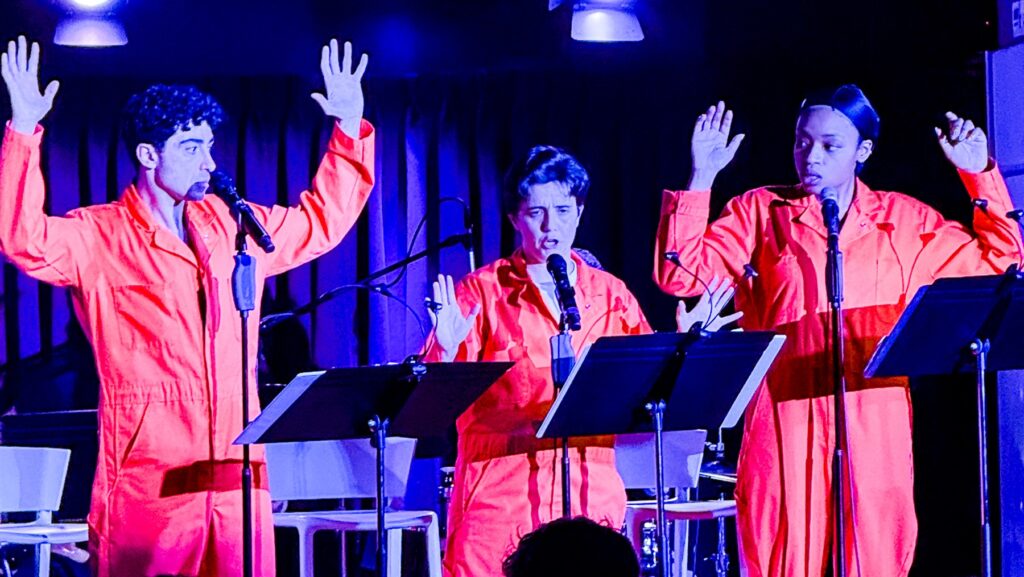
It’s Monday night and Luigi: The Musical has made its New York City debut as a staged reading to a sold-out crowd at the Green Room 42, a cabaret club in Hell’s Kitchen. Four actors sit on chairs on stage, three are dressed in orange jumpsuits and one wears a prison guard uniform. The three incarcerated characters are meant to represent United Healthcare CEO shooting suspect Luigi Mangione as well as convicted felons Sean “Diddy” Combs and cryptocurrency entrepreneur Sam Bankman-Fried. The musical focuses on an imagined friendship between the three men, who at one point were all being held at the Metropolitan Detention Center in Brooklyn.
“These are three men who represent the three pillars of American life that people have lost trust in over the past 15 years,” the musical’s creator Nova Bradford explains. She refers to healthcare, Hollywood, and Big Tech. “Symbolically, we’re telling a story about America’s relationship to these institutions through the story of these three individuals in prison.”
Satire as Social Commentary
The plot is loosely about the three famous inmates planning a prison escape, but it functions primarily as a critique of society’s relationship with celebrity worship, with commentary about the for-profit healthcare industry woven in. The script balances serious moral and ethical conversations about fame, political violence, and powerful institutions with absurdist humor. It questions why we, as a culture, venerate certain figures while examining the disparate cultural responses to high-profile criminals.
The production marries commentary with over-the-top satire, including a running joke where Mangione writes in his diary, singing, “Dear Manifesto.” Just when the tone shifts toward emotional sincerity regarding healthcare denials, the play pivots back to satire, such as a joke about fan girls sending Mangione their underwear.
“It doesn’t matter what you’re famous for, it just matters that you’re famous,” the character playing Diddy tells the character playing Mangione. The play suggests that the public is addicted to being angry and scared, and that figures who keep them in that state are rewarded with virality.
Navigating a Media Storm
Bradford notes that she was inspired to write the show after observing the polarizing public response to Mangione’s arrest. “The way the public’s response seemed to be divided didn’t seem to fall across existing political polarization,” she says. “As a satirist, that was an interesting subject that caused me to think, ‘What’s going on here?'”
The production team has faced criticism from some who believe the show celebrates Mangione. Bradford clarifies that the show is “very explicitly neither pro nor anti” the subject. “We’re engaging with all of the types of responses that the audience might be having, so the goal is that, regardless of someone’s existing opinions on the subject matter, they will see the show and find that their perspective is both reflected and also challenged.”
The musical is currently a work in progress, with the creators hoping to eventually mount a full-scale production in New York City. The media attention surrounding the show—including mentions by Stephen Colbert and Bill Maher—has been a surreal experience for the troupe. “Part of the motivation for wanting to write the show was seeing the media circus that happened around the case,” Bradford says. “And then before the show even opened we found ourselves at the center of the very phenomenon we sought to critique.”
As the legal proceedings against Mangione continue, the musical serves as a reminder of the complex relationship between art and politics. “Art and politics have always been intertwined from the very beginning,” says Mike Cefalo, the actor playing Mangione. “Neither could exist without the other, and I think that this show shines a spotlight on that very sentiment.”