
Trump’s Greenland Takeover Could Be Silicon Valley’s Libertarian Dream Come True
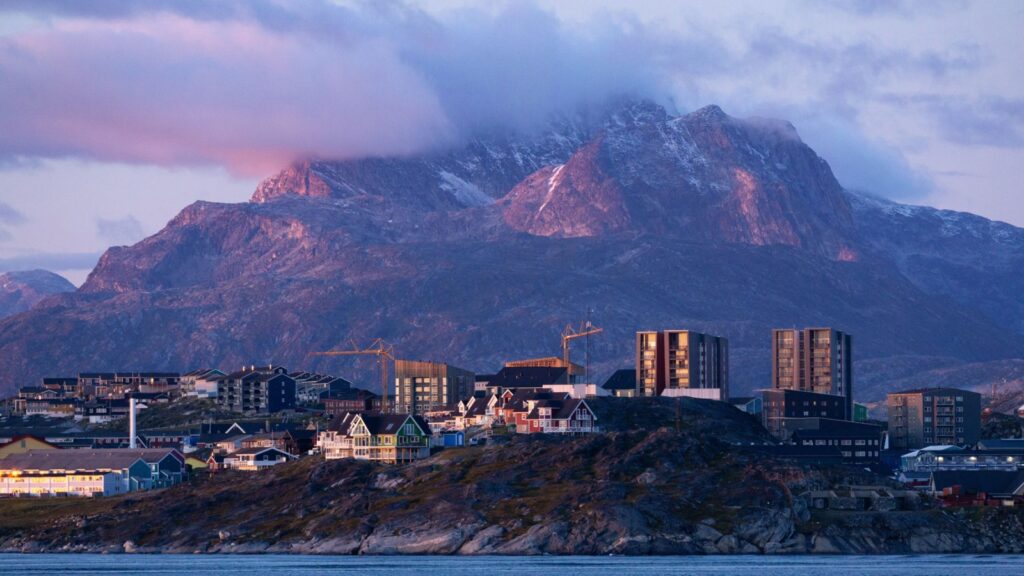
There are any number of reasons why Donald Trump is obsessed with annexing Greenland, an autonomous territory that belongs to the Kingdom of Denmark. From a strategic perspective, the world’s largest island could serve as a perch to assert American military might in the Arctic Circle and establish trade routes in the region to compete with Russia and China. Plus, Greenland itself is rich in natural resources ranging from oil to iron ore to rare earth elements. Of course, one can’t discount Trump’s desire to expand U.S. empire for its own sake (while threatening NATO allies, of course).
Meanwhile, some of Trump’s most influential allies — the Silicon Valley oligarchs who spent hundreds of millions of dollars to help him retake the White House in 2024 — might see a different potential in turning Greenland into a satellite colony. For decades, libertarian-minded tech executives have dreamed of creating a sovereign territory free of regulatory oversight and tax structures, envisioning a free-market, stateless utopia where they can pursue their wildest ambitions and accrue even greater wealth. A MAGA-led takeover of Greenland could be exactly what they’re after, since it offers a vast, mostly untouched environment for all kinds of harebrained experiments they can’t carry out on U.S. soil. Everything is on the table, from the testing of new AI networks and cryptocurrency-based economies to unchecked industrial transformation of the landscape and simulations of what it would take to support human life on other planets. To our tech overlords, it could be a playground without rules.
Billionaire Peter Thiel, one of the first investor-entrepreneurs of his cohort to come out in support of Trump, has been one of the most reliable proponents of such schemes. In 2008, he became a founding investor in a San Francisco nonprofit called the Seasteading Institute, which aimed to develop the means to create artificial island micronations. The following year, Thiel wrote in an essay that the prospect of settling the oceans was “tentative” but “much more realistic than space travel.” He noted that “the great task for libertarians is to find an escape from politics in all its forms,” a view that informed his interest in building a “truly free” society from scratch. Thiel had been brought aboard the project by venture capitalist Joe Lonsdale; the pair are co-founders of the data and analytics software company and military contractor Palantir, and Lonsdale initially served as a chairman of the board at the Seasteading Institute.
Over the years, however, Thiel and others began to sour on the manmade island concept. Lonsdale wrote in a post on X last year that the financial and logistical hurdles are still too significant. “My first TV interview 17 years ago was as chairman of the Seasteading Institute — which I had introduced to Thiel at the time to explore how we start new countries and innovate on [government],” he said. “Turns out it is very, very expensive, and we have to build and fix other things first.”
By the end of the 2010s, the libertarian billionaire class had turned its attention to existing land, proposing ways of carving out vacant areas from various regions to construct tech-driven, self-run cities according to their own political idiosyncrasies. For them, the most obvious appeal of Greenland is that it’s already there and sparsely populated, saving them the trouble of trying to manufacture a floating platform to prop up massive buildings in international waters. It also doesn’t hurt that the island geographically positioned between North America and Europe while offering increased access to China and Russia as polar ice continues to melt, making it a likely future crossroads for shipping routes, and therefore a hub of rapid commercial development, perhaps a boomtown not unlike Silicon Valley itself.
The test cases for libertarian sanctuaries on undeveloped territory, many of them tied to plans for decentralized cryptocurrency economies, have not been particularly fruitful. Akon City, a blockchain-powered project in Senegal led by and named for the musician, fell apart in 2025, eight years after it was first announced. Liberland, another crypto-focused micronation founded on a small patch of land in Croatia by the Czech libertarian activist Vít Jedlička in 2015, remains an uninhabited forest more than a decade later. Its more than 1,000 theoretical “citizens” did, however, recently elect Justin Sun, a Chinese-born crypto billionaire, as prime minister of the unrecognized country. (The SEC paused a civil fraud enforcement action against Sun after he poured tens of millions of dollars into the Trump family’s own cryptocurrency ventures.)
In 2019, Patri Friedman, grandson of economist Milton Friedman and former executive director of the Seasteading Institute, incorporated the VC fund Pronomos Capital with the aim to raise independent cities on unused land in developing countries. Its investors included Thiel as well as crypto entrepreneur Balaji Srinivasan, the former Coinbase CTO who once gave a speech essentially advocating for Silicon Valley’s secession from the U.S., or an “ultimate exit,” by way of an “opt-in society, ultimately outside the United States, run by technology.” Srinivasan has also published a book arguing that such privatized, business-friendly enclaves will eventually surpass nation-states. (He is currently listed as an adviser to Pronomos.) Another source of seed money for the fund was venture capitalist Marc Andreessen, now an enthusiastic Trump mouthpiece, who in his 2023 “Techno-Optimist Manifesto” advocated for an accelerationist model of material progress without government constraints on innovation. (Srinivasan was for a time a partner at Andreessen’s VC firm.)
One Pronomos-backed vision is Próspera, a charter city that broke ground on the Honduran island of Roatán in 2017, with Venezuelan wealth fund manager Erick Brimen as CEO. But despite the establishment of its own civil codes and administrative bodies for dozens of full-time inhabitants and some 2,000 paying “e-residents,” Próspera’s long-term viability is threatened by its placement within the borders of Honduras, which in 2022 repealed the economic zoning law that allowed its architects to move in. For the moment, the city maintains that it is still entitled to the 50 years of autonomy guaranteed by that law.
Silicon Valley’s ultra-rich isolationists have dabbled in tracts closer to home, too, with a proposed development called California Forever. In 2023, it was revealed that major industry players had helped a subsidiary company called Flannery Associates stealthily buy up tens of thousands of acres of relatively cheap farmland in Solano County, on the edge of the San Francisco Bay Area, for about $800 million over several years. Andresseen was among them, as were LinkedIn co-founder Reid Hoffman and Laurene Powell Jobs, the widow of Steve Jobs and president of the investment group the Emerson Collective. The brainchild of Czech entrepreneur Jan Sramek — also the CEO of California Forever — the site is meant to become a walkable city of 400,000 (nearly the present population of the entire county), despite strong local opposition to the proposal. Sramek has claimed that building up the infrastructure of the city will provide thousands of construction jobs for the next 40 years.
The company Praxis launched the same year as Pronomos with much the same goals, pitching a new city on the Mediterranean coast. As of 2023, co-founder and CEO Dryden Brown, a college dropout and former hedge funder with no experience in real estate development, had raised more than $19 million with the concept, including from Pronomos, Paradigm Operations (the crypto-centric VC firm of Coinbase co-founder Fred Ehrsam and Matt Huang, a Sequoia Capital partner), Lonsdale, Srinivasan, and entities associated with OpenAI CEO Sam Altman, crypto billionaires Tyler and Cameron Winklevoss, and convincted crypto fraudster Sam Bankman-Fried. Former Praxis employees have said that Brown has the additional distinction of imagining his micronation modeled on the ideals of “authoritarian fascism.”
And it’s Praxis that, like Trump, has since set its sights on Greenland as a zone of manifest destiny. In November 2024, a week after Trump’s reelection (and five years after he first floated the fantasy of seizing Greenland), Brown posted a thread on X in which he said he had traveled to the island to discuss buying it, claiming that he now had $525 million in financing from his deep-pocketed investors. He framed Greenland as an ideal proving ground for interplanetary exploration. “Greenland is an actual frontier,” he wrote. “It’s hardcore. If humanity is going to build Terminus on Mars, we should practice in Greenland. It can serve as a sandbox for terraformation experiments, funded by realizing its potential as a mining and industrial hub.” (It’s not clear how Greenland’s climate provides any meaningful comparison to that of Mars, which has a thin atmosphere almost entirely composed of carbon dioxide.)
Like others, Brown pointed out Greenland’s rich mineral reserves, though he did not specifically mention rare earth elements. Billionaires Jeff Bezos, Bill Gates, and Michael Bloomberg, and OpenAI’s Altman, have reportedly invested in Greenland mining operations, recognizing its rare earth deposits as invaluable for the manufacturing everything from electric car batteries to military equipment to the chips and infrastructure for AI tech. China currently has a stranglehold on the supply of these crucial minerals, and has likewise invested in Greenland’s mines. Tech companies and the moguls behind them no doubt see control of the islands’s very foundation as a key advantage in the global marketplace.
Seemingly encouraged at every turn by those who stand to profit from it, Trump continues to peddle his belligerent expansionist rhetoric toward Greenland, indifferent to the population’s hostile response and Denmark’s attempts at reasonable diplomacy. (Notably, the U.S. ambassador to Denmark, Ken Howrey, is another longtime Thiel associate; the two are both PayPal co-founders.) But it’s entirely possible that, seeing only the riches and thrill of dominance that a conquest offers, the president is not fully aware of the more ideological motivations harbored by his libertarian donor class, and their yearning for a technocratic settlement somehow beyond U.S. influence.
Unlike others of his ilk, Elon Musk, nominally more interested in colonizing Mars than other parts of Earth, appears to see the annexation of Greenland as a purely nationalistic venture. “If the people of Greenland want their territory to join America, we should accept them!” he cheerfully posted a year ago on X, before the inauguration of a head of state he helped to install and then worked alongside for months as head of the failed, misleadingly named Department of Government Efficiency. There was no mention of the unregulated offshore haven that his peers have been trying to will into being for more than a generation, just the naïve assumption that the island’s approximately 56,000 inhabitants would gladly invite the Trump regime to invade and plunder their home.
As for everyone else in Musk’s orbit, this clearly isn’t about a symbolic MAGA win. It’s a chance to forge a country of their own — with Trump’s arrogance perhaps no more than a means to that end.