
Are Authorities Closing In on Olympian Turned Drug Kingpin Ryan Wedding?
T
he man known as El Jefe, or the Giant, or Public Enemy was once close to Jonathan Acebedo-Garcia. Whether they considered themselves friends or just business associates is unclear, at least from court records. What is certain is that they trusted each other with information dangerous enough to result in either one of them ending up dead.
They had met in 2011, at Reeves County Detention Complex in West Texas, the largest for-profit prison in the world. Sprawling over 80 acres of bleak and barren desert, the facility could feel dangerous and overcrowded (it housed roughly 4,000 inmates) with a staff that struggled to keep up; in 2009, Reeves was the site of back-to-back riots in which inmates burned mattresses to protest the persistent use of solitary confinement and lack of adequate medical care.
El Jefe wasn’t El Jefe yet, or the Giant, or Public Enemy. He was just Ryan Wedding, a 27-year-old hulking former Olympian serving out the last bit of a sentence on a cocaine deal gone bad. According to records from the Bureau of Prisons, he had no behavioral problems while incarcerated. The U.S. Attorney’s office had agreed to his extradition back to Canada.
By 2013, both Wedding and Acebedo-Garcia were out of prison and in communication nearly every week, sometimes several times a day, according to U.S. federal prosecutors.
In the ensuing decade, Wedding would follow a path few could have predicted. Rather than returning to Canada and finishing college, as his parents once told me they hoped he would, Wedding would become one of the biggest drug traffickers in North America, routinely moving hundreds of kilos of cocaine from Colombia through Mexico and Southern California to Canada, according to an indictment filed in October 2024. The indictment revealed that someone who had worked with Wedding for over a decade had agreed to cooperate with law enforcement and to testify at trial.
On the day the indictment was unsealed, or sometime shortly thereafter, Wedding began plotting to have the potential witness killed, according to recently filed court documents. Not long after, Wedding was placed on the FBI’s Ten Most Wanted list.
On Nov. 19, 2025, at a press conference in Washington, D.C., U.S. Attorney General Pam Bondi announced a new indictment with nine additional charges against Wedding, including two counts of witness tampering and intimidation, money laundering, drug trafficking, and murder. Flanked by FBI Director Kash Patel and the Commissioner of the Royal Canadian Mounted Police (RCMP), Bondi also announced the arrest of 12 more members of Wedding’s organization and that the reward for his capture had been raised from $10 million to $15 million. While the indictment does not name Acebedo-Garcia as the murder victim, several sources close to the investigation confirmed to me that he is indeed the victim referenced in the indictment.
For those who have followed the Wedding case, the indictment was a bombshell. Besides revealing a murder plot that allegedly involved a Colombian madam and a crime blogger, it exposed the inner workings of what Bondi called one of the most prolific and violent drug trafficking networks in North America. And while the comparisons Patel made to Pablo Escobar and Chapo Guzman seem grossly overblown, if the allegations against Wedding are true, he is one of the most notorious Canadian drug traffickers in history: Federal prosecutors allege he moved 60 tons of cocaine a year from Mexico to the United States and Canada, with annual revenues of roughly $1 billion.
The indictment also reveals an organization that is allegedly global in reach: an Italian special forces operative who trains sicarios; money launderers in the U.K., Toronto, and Italy; a Mexican wife; a Colombian girlfriend, and a Mexican nicknamed “The General,” who allegedly has connections in the Mexican government he leverages to protect Wedding.
It would seem, based on the indictment and other recent developments, that law enforcement has infiltrated Wedding’s inner circle, and it is only a matter of time before he is captured.
On Dec. 24, police in Mexico announced that they had raided four properties belonging to Wedding in Mexico City and the surrounding state of Mexico. They seized 62 motorcycles worth a reported $40 million, what they described as “works of art,” marijuana, meth, ammunition cartridges and magazines, and two Olympic medals (it is unclear who won the medals; Wedding placed 24th at the Salt Lake Winter Games in 2002).
I have been reporting on Wedding for Rolling Stone since 2009, when he was first indicted, and later found guilty of multiple counts of conspiring to traffic cocaine into Canada. I traveled to San Diego for that trial, where I met Wedding’s mom and sister, and later to Vancouver, where he had grown up and become an Olympian, and visited his home and the family ski cabin at Whistler. In the months before and after, I talked with friends of his who had known him (and in some cases worked with him) when he first got into the drug game growing marijuana.
I reached out to these same sources when Wedding was indicted in 2024, but only a few returned my calls. Wedding was on the run, after all, and if the allegations against him are correct, he’d spent the previous decade and a half since his first conviction transforming himself into a bona fide narco kingpin who has allegedly orchestrated contract killings in the United States, Canada, and Colombia.
For the past year I have made repeated attempts to interview Wedding, including traveling to Culiacán, Mexico, where he is reportedly under the protection of the Sinaloa Cartel, to get his side of the story. He does not have a lawyer representing him in this case, and friends and family who spoke to me in 2009 in his defense either declined to speak with me about the latest charges or did not respond to repeated requests for comment. Lawyers of alleged associates either did not return calls or declined to comment.
Several sources close to the investigation, however, have told me the FBI, with the cooperation of Mexican and Canadian law enforcement, is closing in on Wedding.
“Not only are they in on his inner circle; they clearly have someone very close to him [cooperating],” former FBI agent Brett Kalina, who arrested Wedding in San Diego in 2008, tells me. “My guess is they know exactly where he’s at and it’s just a matter of time before they can get him out of there.”
IT WAS FEBRUARY OF 2014, and Ryan Wedding was broke. He’d been out of prison for a little over two years and was living in a gated community in the Vancouver suburb of Coquitlam with a woman he’d married while in prison. He was leasing a new Ford F-350 pick up, but beyond that, he didn’t have much (the only other asset he claimed was $3,000 in clothes). He was $673,000 in debt and unemployed, living off “financial support from family members.”
“I, due to being in prison for several years, unable to work and contribute to the household, was unable to fulfill my financial obligations as they became due,” Wedding wrote in a bankruptcy filing.
Wedding’s wife had been named in at least two Canadian drug trafficking investigations, according to the CBC, including an October 2011 case in which she allegedly listened in on the kidnapping of a drug trafficker who was held at gunpoint over a missing $400,000. (The couple has since divorced.)
The year after Wedding declared bankruptcy, his name surfaced in a major Canadian drug investigation called Operation Harrington, which had begun after a large load of cocaine from the Caribbean was seized off the frigid coast of Nova Scotia. The investigation into how the cocaine got there eventually traced back to Wedding, but he was never arrested.
In 2022, prosecutors at the Central District of California, which is headquartered in Los Angeles, began to shift their strategy in dismantling drug trafficking organizations, Martin Estrada, the former U.S. Attorney for the district, told me. Rather than trying drug cases using traditional methods — such as sentencing guidelines related to the quantity of drugs seized, or associated violence — they would target the leaders of these groups as organized crime figures, using RICO statutes that had effectively crippled the mob.
As part of this effort, the FBI and the DEA, in coordination with local law enforcement agencies and the RCMP, focused on the transportation networks moving serious weight across the Mexican border, and found that Indo Canadian gangs were particularly prolific in bringing drugs into Canada. As the authorities began to infiltrate these networks and seize large loads of cocaine, fentanyl, and meth, one name kept coming up: Ryan Wedding.
Wedding’s rise through the drug world, as Rolling Stone previously reported, could be attributed to a combination of intelligence, fearlessness, and a capacity for violence. By 2015, living in Montreal, he already had connections with the Sinaloa Cartel, which he may have established while in prison in Texas; links to Russian and Iranian organized crime groups from his time in Vancouver; and friends in the Montreal mob, which had long been the most efficient and ruthless drug trafficking organization in Canada. According to Liam Price, the former director-general of the RCMP, Wedding also worked with the Wolfpack Alliance, a loosely organized coalition of biker gangs including the Hells Angels, to move cocaine once it reached Canada.
“What we’ve seen with the drug trafficking landscape over the years is that it’s very fluid … rather than purely hierarchal,” Price told me. “These are very sophisticated opportunists that work in a variety of ways across jurisdictions to work around people like ourselves.”
Eventually, according to the recent indictment, Wedding became the largest supplier of cocaine to Canada. He sourced his cocaine, federal prosecutors say, from Colombia, cooking and testing it in kitchens his organization ran with a Colombian paramilitary group. From there, prosecutors say, Wedding used boats and planes to move hundreds of kilos at a time from Colombia to Mexico. The eventual goal was control of the Canadian drug trade.
In early 2023, the FBI began targeting Wedding specifically, a source close to the investigation tells me, and assigned the case to an agent who had been with the Bureau since 2014 and specialized in cross-border investigations (Rolling Stone is not naming the agent at the request of the FBI for the agent’s safety). In the summer of 2023, the agent approached the RCMP sergeant posted to Los Angeles as a liaison officer. The U.S. government needed Canada’s help to dismantle Wedding’s network.
IT IS NOT CLEAR WHEN or how American law enforcement came into contact with Acebedo-Garcia, but according to sources close to the investigation, the FBI met with him in late 2023 and he agreed to cooperate and to eventually testify at trial.
Acebedo-Garcia and Wedding made an odd pair. Both were Canadian, but they came from very different backgrounds. Acebedo-Garcia grew up in Montreal, the son of Colombian immigrants, and often helped his family in their cleaning business. Wedding had a trust fund, and according to friends I talked to back in 2009, was treated like an athletic boy wonder who was expected to do nothing but race, work out, and eat right. Ryan’s dad told me he sometimes spent $40,000 a year to support his son’s quest to become an Olympian, which required yearlong training and a race circuit that took him to Chile, Italy, and Austria.
Where Wedding was brash and arrogant by nature, his pal Acebedo-Garcia mostly kept to himself, the sort of person a friend would later tell the Toronto Star was a bit of an enigma.
Acebedo-Garcia had been arrested around the same time as Wedding, trying to move 23,000 ecstasy pills cut with meth from Canada into New York. That’s how he ended up in prison in Texas, where he and Wedding met.
More than a decade later, in January 2024, Acebedo-Garcia met with Wedding and his number two, a 35-year-old former Toronto elevator mechanic named Andrew Clark, at a Starbucks in one of Mexico City’s most upscale neighborhoods, called Santa Fe. They were there to finalize what had the potential to be a very lucrative long-term arrangement: moving 2,000 to 3,000 kilos of cocaine a month into Canada, including 600 kilos destined for Alberta specifically. The plan was to use a Toronto-based network of truckers to move the coke from Southern California, with a flat rate between $175,000 and $250,000 per shipment.
“Really nice to meet u bro,” Acebedo-Garcia texted Clark after an initial meet-up to discuss the deal, according to excerpts of their chat included in Ontario court filings. “Yes bro,” Clark responded. “Very nice to meet you.”
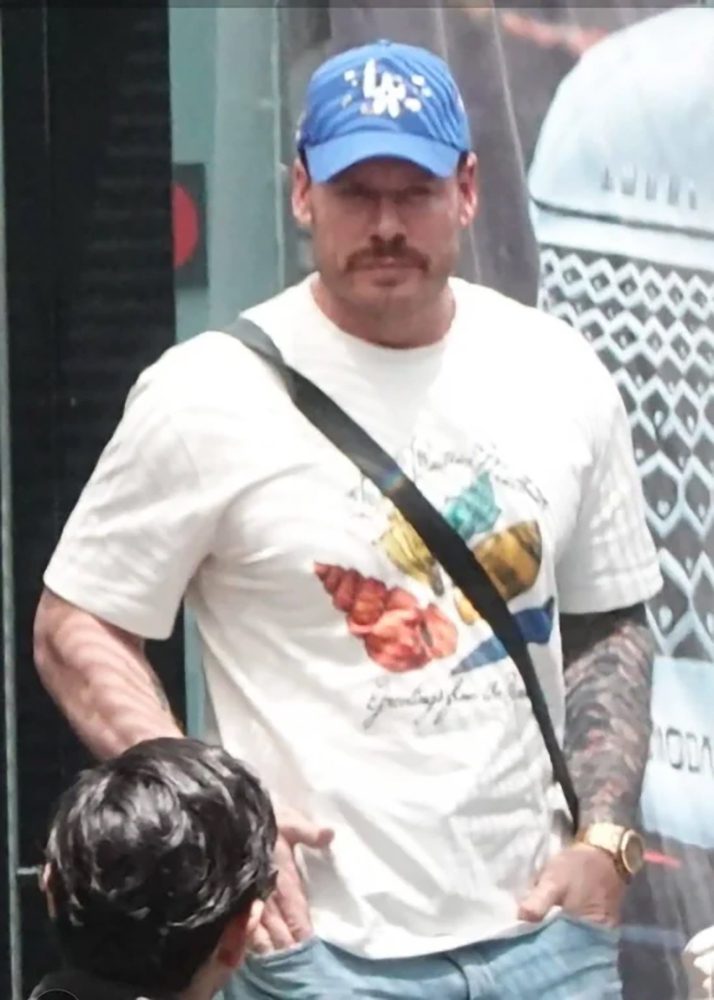
Wedding didn’t realize until much later that the FBI was monitoring Acebedo-Garcia’s texts and even directing him what to say. Nor did he realize that their meeting at Starbucks was under surveillance. When Wedding left the meeting, he was captured on camera, the first documented sighting of a man Canadian law enforcement had wanted for questioning for nearly 10 years. Rumored to have had plastic surgery, Wedding looked different than the last known photo of him, a picture from a Quebec driver’s license taken in 2013. He wore a Louis Vuitton T-shirt that retails for $1,300 and a Dodgers hat. He had a mustache and a tattoo sleeve that covered his left arm. At 42, he had retained his bulk and his muscular frame.
Wedding leaving a meeting with associates at a Mexico City Starbucks in January 2024.
Federal Bureau of Investigations
A month later, in February 2024, Acebedo-Garcia traveled to Toronto to meet two men: Gurpreet Singh, 31, and his uncle, Hardeep Ratte, 45. During that meeting, which court documents allege took place at an auto body shop in the Toronto suburb of Brampton, Ratte and Singh agreed to haul cocaine from Southern California into Canada at a flat rate of $220,000 a load. They would hire the truckers, who would fly to L.A. to pick up drug shipments from Mexico. Acebedo-Garcia would serve as a go-between, providing the truckers with a dollar-bill serial number that functioned as a sort of password. Once the code was given, Wedding’s associates would hand over a shipment of cocaine — up to 350 kilos per run — which the truckers would then smuggle into Canada.
The following month, Acebedo-Garcia arranged the details for the first shipment — 293 kilos. Ratte created a text thread titled “Family Group” with Acebedo-Garcia and Singh to coordinate the specifics.
On March 4, 2024, two drug mules met up near a warehouse off a highway in San Bernardino, California, which is 60 miles east of L.A. in the Mojave Desert. Undercover agents on site watched as they moved boxes of cocaine from one vehicle to the other, while more law enforcement watched from above via “an airship with high-definition cameras.”
Once all the boxes had been transferred, Wedding sent Acebedo-Garcia a screenshot of a message he’d received from his couriers in San Bernardino: “Listo boss entrengada la encomlenda [sic] de 293,” it read. “Done boss delivered the order of 293.” The FBI was monitoring the messages in real time.
A week later, FBI agents flew with Acebedo-Garcia to Dubai, where he met with Singh to discuss another deal (according to the CBC, Singh was connected to organized crime figures there). Because the FBI couldn’t obtain legal permission to record the meeting from the government of Dubai, Acebedo-Garcia debriefed agents later about the specifics of the conversation.
Not long after, things started to go wrong for Wedding’s operation. First, on April 9, police seized 375 kilos from a driver near Riverside, California. The cocaine, had it made it to Canada, would have had a street value of $14 to $22 million.
That August, two truckers who worked for Ratte and Singh were stopped at the Blue Water Bridge, which is about an hour from Detroit, at a little after 3 a.m. The drivers would later admit to federal prosecutors that they had been running drugs from Mexico since April of that year and that they typically hauled legitimate cargo to mask the drugs they were carrying, which they stashed in hidden compartments.
On this trip, they told customs officers they were hauling steel bars, but when the officers had the truckers pass through an X-ray tunnel, the imagery revealed something that shouldn’t have been there: a long thin compartment above the trailer’s Ontario license plate. Inside that compartment, police found bricks wrapped together in cellophane, which they removed and stacked on the loading bay floor. All told they seized 115 bricks of cocaine and heroin that morning, weighing more than 124 kilos. (Both drivers have pleaded guilty.)
As more loads were seized through the summer and fall of 2024, Wedding began to rely increasingly on one of Toronto’s most colorful criminal defense attorneys, Deepak Paradkar, for information, according to the indictment. Flamboyant and controversial, Paradkar lived in a $5 million home in Thornhill, a suburb of Toronto, and went by the handle cocaine_lawyer on Instagram. He wore Louboutins and once posted a picture on Instagram of a yellow Lamborghini with the caption “Cocaine pays lol!!!”
Paradkar played a key role in the Wedding organization by recommending couriers to haul drugs and keeping their identifying information in case a load went missing, according to recently filed court documents in Ontario. At Wedding’s behest, authorities say, he would investigate when loads were seized, paying lawyers to feed him information about the case, including if the drivers arrested were cooperating with law enforcement. (Paradkar has pleaded not guilty. His attorney, Ravin Pillay, declined to comment to Rolling Stone. Pardkar was released on $5 million bail in late December.)
According to federal prosecutors, when 521 kilos were seized on Oct. 1, 2024, near Hazen, Arkansas (a town of roughly 1,000 people off I-40), Wedding texted Clark about the seizure and Clark allegedly responded, “Deepak on it.” Clark then allegedly told Wedding they were looking into it and were planning to “shut the driver down” and “kill everyone involved.”
Clark then created a Threema group chat titled “911 arkansa” and added Paradkar and someone he referred to as Champion, who said he had the location of one of the drivers, according to the federal indictment. A few days later, Champion told Clark he would be fine if Clark had both drivers killed. Paradkar responded that they shouldn’t discuss the murder plot on that thread, prosecutors say. “Clear this convo,” he allegedly texted. “Set up a separate group for you….Only lawyer stuff for me.”
By the time U.S. federal authorities announced charges against Wedding and 14 others in October 2024, they had confiscated more than a ton of cocaine, raided an associate’s mansion near Miami (the former home of DJ Khaled), and arrested key players in the Wedding organization, including Clark, who was taken into custody in Guadalajara by the Mexican Navy on Oct. 8.
When federal drug trafficking, conspiracy, and murder charges were announced against Wedding on Oct. 17, and the indictment unsealed that same day revealed that the government had a cooperating witness, Wedding suspected he knew who it was, according to recently filed Canadian court records. But he wanted help confirming his hunch, so he reached out to a 40-year-old named Atna Ohna from Montreal, reportedly a longtime enforcer for the Italian mafia and biker gangs based in Montreal. According to Canadian court records, Ohna reached out to Acebedo-Garcia via text and concluded that he was, in fact, working with U.S. law enforcement. His hunch confirmed, Wedding began plotting to kill Acebedo-Garcia and put a $5 million bounty on his head, according to the new indictment.
Around the same time, Wedding enlisted the help of a woman named Carmen Yelinet Valoyes Florez, who according to prosecutors ran a network of commercial sex workers, including a Colombian woman living in Orlando named Yulieth Katherine Tejada. On a video call, prosecutors say, Florez and Wedding asked Tejada if she would go to Colombia to lure Acebedo-Garcia to a spot where he could be killed. If she did, Wedding would pay off her mortgage, and some needed corrective cosmetic surgery. Tejada agreed.
By January, Florez had located Acebedo-Garcia. He’d left Canada that summer, according to the Toronto Star, shipping a Harley Davidson and two Sea-Doos to La Florida, one of the most exclusive neighborhoods in Medellín. It was rumored that he was living in a “castle-like” mansion in the Colombian countryside with tennis and basketball courts.
On Jan. 29, 2025, Wedding allegedly sent Clark surveillance footage of their target in Medellín, and two days later, a crew of hitmen began to set in motion the final stages of the murder plot. The killing would take place in a neighborhood called El Poblado, one of the more affluent areas of Medellín, where luxury apartment towers rise from land thick with palm trees and tangled overgrowth of what had once been the jungle floor. It would occur at a locals-only spot, a restaurant in a strip mall called El Indio.
A member of the crew arrived first to case the restaurant, according to the November indictment, while someone else followed Acebedo-Garcia to El Indio on a motorcycle. Not long after Acebedo-Garcia sat down to eat, a sicario in a gray hoodie entered the restaurant and shot him in the head five times. The hitman quickly fled on a motorcycle, while a photographer contracted for the job took pictures of the corpse, per the indictment, which were later sent via Threema to Wedding.
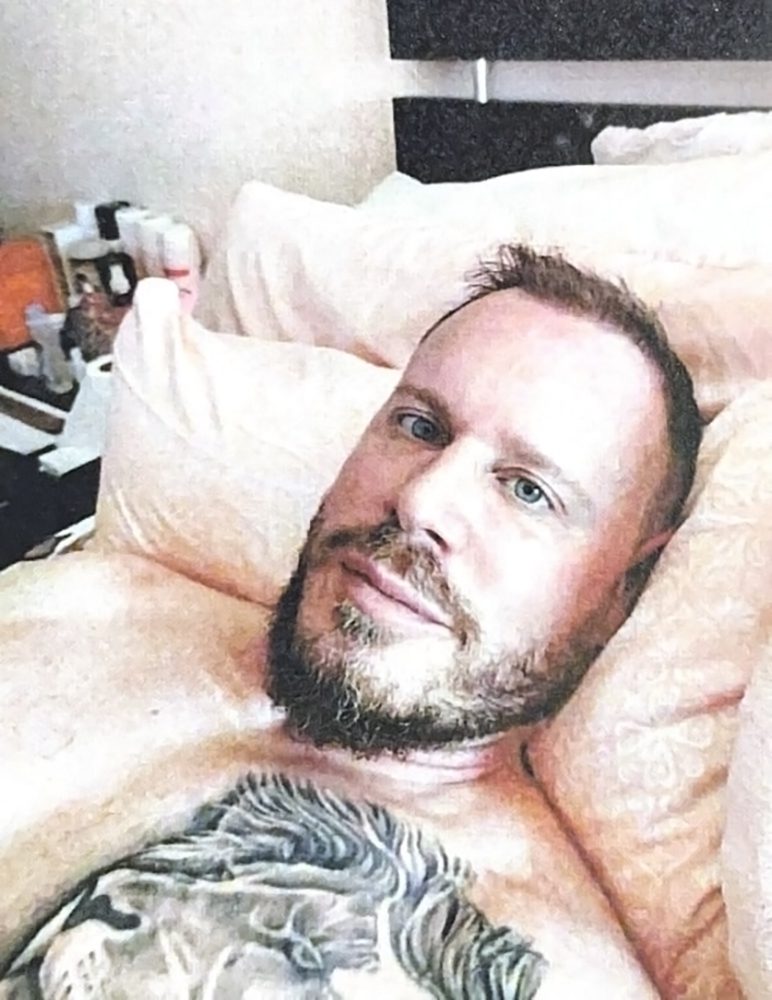
A photo of Wedding recently released by the FBI and purported to have been taken last summer.
Federal Bureau of Investigations
Wedding paid roughly $500,000 to the murder crew in Colombia, according to court records filed in the U.S. and Canada, and $300,000 to Ohna, split between $150,000 in cash and 30 kilos of cocaine. He also asked his jeweler in downtown Toronto, a professional poker player also known as “the Jew” or “Sushi,” to make Ohna a necklace to memorialize the successful hit, federal prosecutors say.
On the day of the murder, a gossipy underworld blog called Dirty News posted a story to Instagram that included a picture of the restaurant and the bottom part of Acebedo-Garcia’s body with a caption that read: “BOOM! Headshot.” Prosecutors allege an associate of Wedding had sent Bal the picture and paid him to make posts about Acebedo-Garcia.
“The criminal underworld will always find you,” a caption under the photo read. “The world isn’t big enough to hide.”
A MONTH LATER, IN FEBRUARY of 2025, I traveled to Culiacán in the hopes of finding Wedding for an interview. Because U.S. law enforcement had said he was under the protection of the Sinaloa Cartel, I believed there was a good chance he was in Culiacán, the cartel’s de facto headquarters.
I traveled there with a film crew working on a documentary about Wedding for Rolling Stone. When we arrived, the city was under high alert, and we were told not to go out at night. Since the capture of El Chapo Guzman in 2016 and his extradition to the United States, the two primary factions that made up the Sinaloa Cartel, those loyal to El Chapo and those loyal to El Mayo Zambada, have been at war for control of Culiacán and the cartel itself. President Donald Trump’s hyper-aggressive stance toward the cartels — declaring them a terrorist organization, flying surveillance drones into Mexican airspace — had only ratcheted up the tension.
We hired a local journalist, Miguel Angel Vega, who has connections within both factions warring for control of Culiacán, to ask around about Wedding. His contacts said they had never heard of him, although they often saw Canadian drug traffickers staying at the same hotel where we were staying, a Marriott next to a luxury shopping mall. It’s where drug traffickers from around the world — the Dominican Republic, Lebanon, the U.K., Dubai — stayed when they came to Culiacán to make drug deals, Vega told me.
While I was there, I met with a group of police officers known as Gringo Hunters, a small unit from the northern Mexico state of Baja California. The unit catches an average of 13 Americans a month and since it was formed in 2002 it has apprehended more than 1,600. But they had no leads on Wedding. They suggested we look at tourist spots popular among Americans and Europeans — Puerto Vallarta, Cabo, Cancún — where a large, buff white man could blend in.
When Wedding’s indictment was unsealed in October 2024 and he became a figure of global fascination — how does an Olympian become a narco kingpin? — law enforcement sources at the U.S. Attorney’s office and the FBI told me they thought it was a matter of time before he was captured. Maybe a few weeks. At most six months. “There aren’t that many places for a six-foot-three white guy to hide,” Kalina told me at the time.
And yet, a year later, Wedding is still at large. There have been several rumored sightings, including one last August in a neighborhood outside of Mexico City.
The FBI declined to comment on this reported sighting but did confirm in August 2025 that they believed Wedding was in central Mexico and launched a social media campaign hoping to elicit tips from residents of the area. Incidentally, this is where the four properties linked to Wedding were raided Dec. 24 are located. When I asked the FBI in December if this was where they thought Wedding was hiding, they wouldn’t confirm or deny, pointing out that if they said where they thought he was, he would flee.
“As far as why he’s evaded capture, I can only offer that he’s a very rich man with wealthy, powerful friends and so he has resources,” FBI spokesperson Laura Eimiller said in an email. “At any given time, the Bureau has hundreds (if not thousands) of fugitives wanted on outstanding charges. Obviously, the Bureau is devoting a great deal of resources to capturing him and we believe we will.”
Wedding is rumored to have high-ranking members of the Mexican government on his payroll, as well as connections to organized crime figures in Dubai, the U.K., and Colombia, which was his original base of operations before he aligned with the Sinaloa Cartel. “I think they know where he’s at,” a law enforcement source said of the FBI. “But he’s being protected, and they just need to separate him. Otherwise, it could turn into some kind of shootout, and they’re not going to put law enforcement at risk to get him.”
It seems highly likely one of Wedding’s most trusted lieutenants is now cooperating with law enforcement. In an extradition request recently filed in the Ontario Superior Court of Justice, references were made to a “cooperating witness” who “met multiple times with U.S. authorities’’ between last February and November. The cooperating witness, according to Canadian court records, “had trafficked drugs with Wedding and assisted Wedding with committing multiple murders.”
In December, the FBI released a new photo of Wedding. Said to be taken last summer, it shows him lying in bed, shirtless, a large tattoo of a lion on his chest. He looks calm, even serene. If you didn’t know who you were looking at, you’d think the picture might be of a man without a care in the world.