

A Billionaire, a Scientist, and a Secret in the Florida Everglades
N
othing could prepare Dr. Thomas Van Lent, one of Florida’s most celebrated scientists, for jail. Before he turned himself in, he bought glasses, laceless shoes, and pants that sat on his hips without a belt. Early on July 17, Van Lent took the Metrorail with his wife to the Miami-Dade County Courthouse. Then, he walked inside to a courtroom where a bailiff placed him in handcuffs as his family watched from the jury box.
Van Lent had devoted his career to the Florida Everglades, becoming its foremost hydrologist, mapping the flow of water and studying how that affected the entire system. He helped build the first computer model of the gargantuan attenuated river, shaped the way scientists communicated across disciplines, and eventually helped lead one of America’s most powerful environmental nonprofits working to save the Everglades, an area larger than the state of Delaware and among the most intricate on Earth.
In the county’s detention facility, only 30 miles from the western rim of the Everglades, Van Lent found himself in a sea of orange jumpsuits, explaining to another inmate what a Stanford Ph.D. did to earn a seat here. He told him he was a scientist, formerly the chief scientist of the Everglades Foundation. Then he explained how the foundation, where he worked for 17 years, sued him. In their lawsuit, the foundation alleged a “secret campaign of theft and destruction” by Van Lent that was motivated by a plot to “enrich himself” by “misappropriation of trade secrets.” Ultimately, a judge found Van Lent guilty of indirect criminal contempt, forced him to pay the foundation’s legal fees, and sentenced him to 10 days in jail. The case unraveled Van Lent’s career, forced him to declare bankruptcy, and it revealed how the Everglades Foundation operated under its CEO, Eric Eikenberg.
Jc Milhet/Hans Lucas/Redux
For more than a decade, the foundation was central to almost every decision, appointment, and piece of earth moved in an at least $25 billion Everglades restoration project. The effort, approved by Congress in 2000 as the Comprehensive Everglades Restoration Project (CERP), is the largest in the world and among the most physically and politically complex, too. The project’s goal is to restore the flow of water through the lower half of Florida’s peninsula that once naturally ran from Lake Okeechobee through the Everglades into the Gulf of Mexico. Central to that plan is a vast reservoir that would store and clean water from the lake before sending it further south into the southern Everglades. But in 2016, the reservoir’s construction became a battlefield between science and politics within the Everglades Foundation, and more broadly among the Everglades coalition. It led Van Lent to resign and spurred the foundation’s lawsuit.
And then, as the foundation’s case against Van Lent spilled into public view, an internal feud concerning the reservoir unveiled an erosion of science within the foundation to maintain its growing political influence with Gov. Ron DeSantis’ administration, according to Van Lent and former employees. Nearly the entire science wing of the foundation left, and some claimed that the science-based nonprofit silenced dissent and transformed into an appendage of the Republican Party under DeSantis. While the foundation secured a steady stream of funding as well as political will for the Everglades, DeSantis recast himself as an environmentalist with the foundation’s support. The question was what that exchange would cost America’s Everglades? And what secrets could even belong to an environmental nonprofit? As Stuart Pimm, the chair of conservation ecology at Duke University, wrote in an op-ed defending Van Lent for the Miami Herald, “There are no trade secrets in science.”
FOR GEORGE BARLEY, A SEVENTH-generation Floridian who worked as a developer, his bond with the Everglades began in Florida Bay’s backcountry and its fishery. When that ecosystem collapsed in 1992, he lobbied, becoming the first advisory council chairman for the new National Marine Sanctuary, and recruited the Everglades’ most tenacious guardian, Paul Tudor Jones II. Jones had built his own hedge fund, becoming a billionaire as eccentric as he was successful. Barley persuaded Jones on the bow of his boat to fund Everglades advocacy, and Jones made good on the promise.
In March 1993, Barley and Jones founded the Everglades Foundation, and the following year, Barley formed the Everglades Trust. The goal was simple: to resurrect and protect the place. They hoped to coalesce the knot of groups working on restoration and shape legislation, because while there were a handful of organizations working in South Florida, everybody remained siloed when it came to the Everglades. They believed a collaborative effort was key.
Then, in June 1995, Barley died in a plane crash. Jones’ devotion grew as he grieved, and Barley’s widow, Mary, became the foundation’s de facto operator. In Barley’s funeral book, Jones wrote, “Rest Easy. I Got Everything Under Control.”
Over the years, the foundation’s influence grew vast, with a board composed of South Florida power brokers. It included the heirs to commercial fortunes, the C-suite of industries, and celebrities like the late Jimmy Buffett. With an annual revenue that reached $28 million in 2024, the foundation dispenses grants to smaller environmental organizations, awards scholarships, and, as its mission states, “is devoted to restoring and protecting America’s Everglades through science, advocacy, and education.”
“The idea was never to have a big organization,” Mary Barley tells me. “What we wanted was to build up these organizations, so that they could do what had to be done. My job was to coalesce these groups, to speak with one voice, to understand the science.”
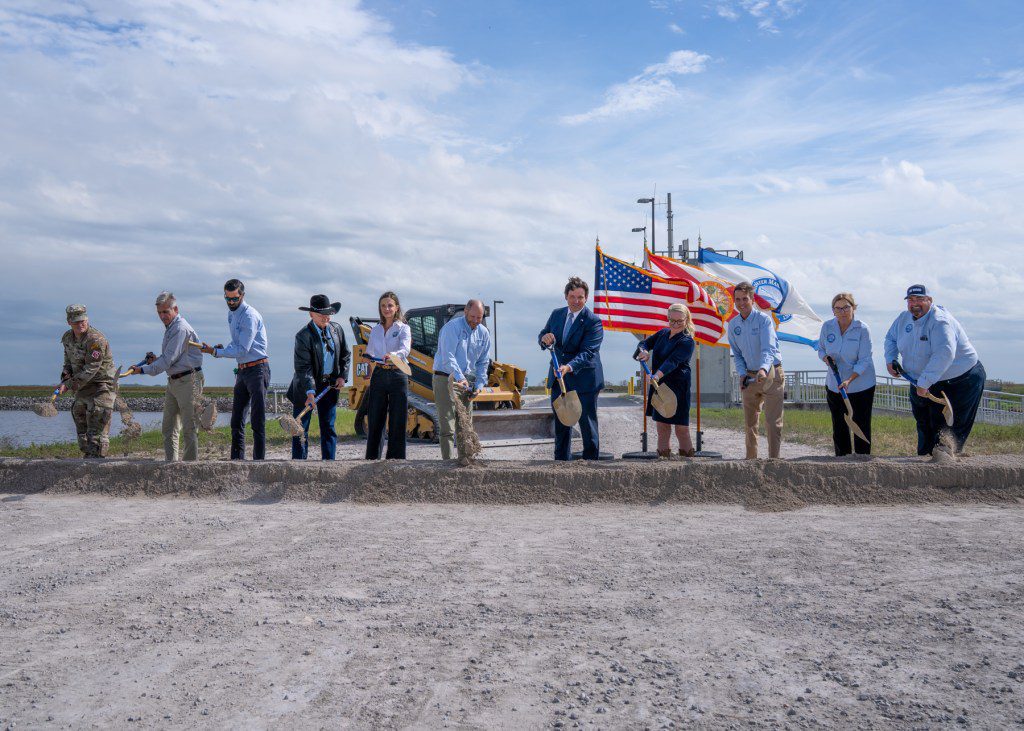
The reservoir was the heart of a litigious battle within the Everglades Coalition.
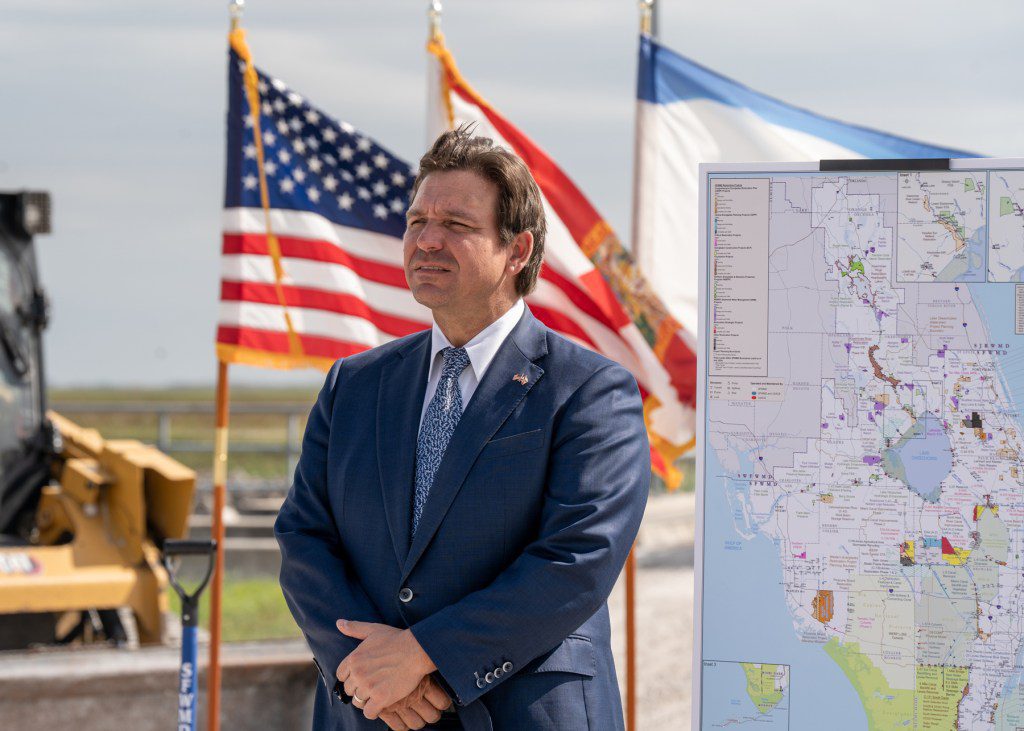
Gov. Ron DeSantis appeared at the groundbreaking for the reservoir’s inflow pump station.
By the early aughts, as CERP, the restoration project, started to take shape, Florida’s environmental community focused on advocacy, largely legislation, because there was almost no formal science staff at nonprofits in South Florida. The Audubon Society was the sole organization with a hydrologist on staff in Florida, but after CERP passed, the goal of most organizations working there shifted to verifying the accuracy of reports, data, and modeling. The members of the Everglades coalition, versed in ping-pong, were now playing tennis. The foundation hoped to mirror government agencies with its own staff so that it could help shape policy but also draw the roadmap for restoration.
First, it hired a hydrologist, then an ecologist, and finally a water-quality scientist. With a tight science wing, an influential board, and a trust to lobby with, the Everglades Foundation became indispensable to the federal and state effort to restore the Everglades. It advised the Army Corps as well as the South Florida Water Management District, the two agencies responsible for the project. And over the past three decades, Barley tells me, “Projects are actually getting in the ground,” before she adds, “If they’re not successful, then who’s going to believe what we’re trying to say? Who’s going to believe in our science?”
AS A KID IN BERESFORD, SOUTH DAKOTA, Thomas Van Lent moved stones in a creek bed to mold the water’s path. He did the same with rocks in the storm drains outside of his house. By the end of high school, he knew he was going to be a water-resources engineer, and his curiosity compassed his career after studying French literature and civil engineering.
He began at the South Florida Water Management District in 1982. At the time, it was building the first comprehensive computer model of the Everglades — the water source for 9 million Floridians between Orlando and Miami today. The first time Van Lent visited Grassy Waters Preserve, an eastern spur of the Everglades, he looked down at the slow sheet of water flowing through the grass and thought about friction. The elaborate network of rainfall, rivulets of ditches, and control structures became a sort of language for Van Lent. “I love thinking about the physics of it,” he says. “That’s how my career in the Everglades went. It was just that day-to-day astonishment at things. It gave what you did everyday a purpose and a meaning — that this place is beautiful. It’s important to save it.”
Van Lent returned to Stanford for his Ph.D. before becoming the chief hydrologist at the Everglades National Park. In 2000, a plan to restore the Everglades galvanized with CERP, an at least $25 billion effort shared by the federal government and the state of Florida. When CERP took shape, Van Lent criticized it. Many in the environmental community felt that the proposed plan to “restore” the Everglades was better described as a plan to “reengineer” the millions of acres not into a natural state but into an engineered jigsaw puzzle assembled in slow-moving water.
All of the engineering and ecological blueprints were bound in an impenetrably dense document known as the Yellow Book. But when Van Lent spoke out in public meetings, he used simple language instead of jargon. And when ecologists or biologists or even fishing guides pointed out blind spots in the plan, Van Lent listened. “I think I caught the attention of a lot of people in the environmental community because I was clear,” he says. “And more often than not, I was right.”
Soon, he became known not just as an expert on the Everglades but as a scientist who gave straight-forward analysis, unafraid of the political zeitgeist. Peers in the community sometimes wrote to him after he spoke, calling him a “rock star.” That’s when a board member approached Van Lent to join the Everglades Foundation in 2005 as its first hire. He oversaw the foundation’s science wing, often appeared in public, became the foundation’s de facto IT specialist, onboarded new employees, and even operated as the interim CEO before Eikenberg took the reins. In his initial interview, Van Lent asked why they were recruiting him. “Well because you speak truth to power,” he remembers one of its founding members said. “And that’s what we want.”
IN JULY, I ARRIVED AT THE Everglades Foundation’s offices in an immense glass complex encircled by dense stands of trees like gumbo limbo and strangler fig just south of Miami. In a retention pond out back, two crocodiles slid around. From Eric Eikenberg’s office on the sixth floor, you can look north toward Miami’s skyline, east across Biscayne Bay toward the chain of coral falling into the Atlantic, and south toward the Everglades.

The state of Florida and Army Corps of Engineers began reservoir construction in 2020.
Rose Marie Cromwell
Eikenberg at 50 is understated, clean-cut in round glasses, and seems like he’d fit in as well in a boardroom as he would at a tiki bar. His enthusiasm feels potent enough to charm a rattlesnake. Although he grew up on Long Island, Eikenberg moved to Fort Lauderdale in high school, where the western edge of the county overlaps the Everglades. His mother served as the Broward County Republican Party’s committeewoman and his father as president and co-chairman of various Broward County Republican groups. Eikenberg fell under the spell of civics in high school when his classmates studied the Bill Clinton campaign in 1992. When he attended college in D.C., he returned home to Florida to answer phones in Congressman Clay Shaw’s office during the summer. Two years after graduating college, he ran Shaw’s reelection campaign. In 2006, Eikenberg became Gov. Charlie Crist’s top aide, and the Everglades absorbed thousands of hours of Eikenberg’s life. By 2012, after moonlighting as a lobbyist, he joined the Everglades Foundation as its president and CEO. When he arrived at the foundation’s office, it was Thomas Van Lent, serving as interim CEO, who gave him a tour.
When Eikenberg started, the foundation had 15 employees, one lobbyist, and $5 million in revenue. Eikenberg’s salary was then $112,020. The next year, discharges from Lake Okeechobee into the coastal estuaries fueled algal blooms that blanketed the bays in cyanobacteria and red tide. Rafts of fish carcasses collected, and tourism ceased in those areas. The foundation seized the chance to show Floridians how the Everglades was inextricably tied to these coastal estuaries via water management, and in turn, they cultivated political will for restoration projects collecting dust — like the reservoir. Not only would the project help the Everglades by reconnecting its historic water source — Lake Okeechobee — to its southern edge, but the reservoir would reduce the discharges from the lake that drove red tide and cyanobacteria.
In only three counties that border the Everglades in southwest Florida, water quality shapes 43,000 jobs, helps generate $5 billion in recreational tourism, and supports an outdoor industry that exceeds $8 billion. In the years when algal blooms blanket the coast, those jobs and figures vanish. Last year, the foundation funded a study by nonprofit Earth Economics that reported more than 84,000 businesses were tied to the health of the Everglades, composing 3 million livelihoods.
By 2016, discharges from Lake Okeechobee fueled another summer of toxic algal blooms, and a bare-bones nonprofit called Captains for Clean Water formed. Founded by two fishing guides, it toured around the state to tell the story of Florida’s disappearing livelihood, linking it to the longstanding neglect of the Everglades. Soon after, the foundation funded Captains for Clean Water, and Eikenberg appeared alongside the nonprofit at events. That summer, the foundation lobbied the state’s senate president to green-light the reservoir that Eikenberg believed was “the only project that was going to get to the heart of the issue.” That was when the foundation’s internal troubles began, with competing visions for the future of the Everglades.
The plan as outlined in CERP was for a massive reservoir to send water south from the Everglades Agricultural Area into the Everglades National Park 50 miles away. Captains for Clean Water, among other environmental organizations, started to use the phrase “Send the water south,” and it became an anthem for the reservoir and Everglades restoration broadly.
But as bulldozers gathered at the site, the foundation raised questions about the reservoir and the land available to build it. The main question was whether the proposed amount of stormwater-treatment areas could in fact meet water-quality standards, because otherwise, the water the reservoir stored wouldn’t be allowed under federal law to enter the national park. In other words, the multibillion-dollar project wouldn’t be operational if water-quality standards weren’t met. Even more concerning was that the reservoir continually shrunk in its scale as owners of the land refused to sell, forcing engineers to work with a smaller footprint and alarming scientists.
The National Academy of Science, a congressionally funded scientific organization that authors an independent assessment of Everglades restoration biennially, raised the same questions about water quality. The Army Corps also wondered whether this would work. Otherwise, American taxpayers would fund a $4 billion pool with no ability to restore the flow of water into the Everglades.
In October 2016, Van Lent published an article with other foundation staff questioning the reservoir’s viability. Eikenberg was livid that Van Lent published the article without his approval. Soon after, the foundation agreed to meet with the Water Management District. Eikenberg, the foundation’s chief counsel, Van Lent, and Dr. Melodie Naja, then the Foundation’s chief scientist, sat down with more than two dozen district staffers. What they intended to be a back-and-forth about their findings turned into an interrogation of Van Lent and Naja, according to Van Lent. Van Lent felt that Eikenberg did little to defend his staff against the district. Afterward, Eikenberg said he offered to publicly chastise the district. Van Lent told him he’d handle it by writing a letter. Something changed, though, because the next morning, Van Lent and Eikenberg entered into a screaming match in Naja’s office for everyone to see. It was the first sign of their feud.
Still, the foundation pushed on. As it persuaded the Legislature to build the reservoir, it lobbied other Everglades organizations as well. Cris Costello, the senior organizing manager at one of America’s largest grassroots environmental organizations, the Sierra Club, remembers that in 2017 the chief operating officer of the foundation called her to say “Don’t make any fireworks,” regarding the reservoir. The foundation’s COO assured the Sierra Club that the reservoir’s design would be solid but “done behind closed doors.” (The foundation’s COO, now its chief policy officer, says, “I don’t remember making such a statement to anyone.”) The Sierra Club often disagreed with the foundation’s approach to policy, but the foundation contributed more than $100,000 annually to fund a position at the Sierra Club solely devoted to the Everglades, so it tended to compromise.
Later that year, Florida’s gubernatorial race began, and a congressman named Ron DeSantis won with a thin margin. By December, Eikenberg joined DeSantis’ transition team, and he appeared so frequently with DeSantis that some members of the coalition joked the governor traveled with a cardboard cutout of Eikenberg, Costello says. Back in Miami, foundation employees watched Eikenberg’s confidence soar. “There was an enormous shift,” Van Lent says.
On his third day in office, DeSantis funneled $2.5 billion into environmental spending and asked the Water Management District’s entire board to resign — the appointed body had been seen as too sympathetic toward polluters for years. DeSantis parlayed the foundation’s tacit support into a powerful image of an environmentalist devoted to water, and as he ascended toward his presidential bid, the foundation drew all they could from the relationship. The reservoir suddenly became the “crown jewel” of Everglades restoration in speeches and brochures. The governor used the hyperbolic phrase as did the foundation. Soon, the Audubon Society used the same language. Captains for Clean Water did, too. Overnight, a project that once was mired in doubt turned into a silver bullet that could save the Everglades. Some members of South Florida’s environmental community wondered whether this project, this crown jewel, was good for the Everglades or good for the Republican Party.
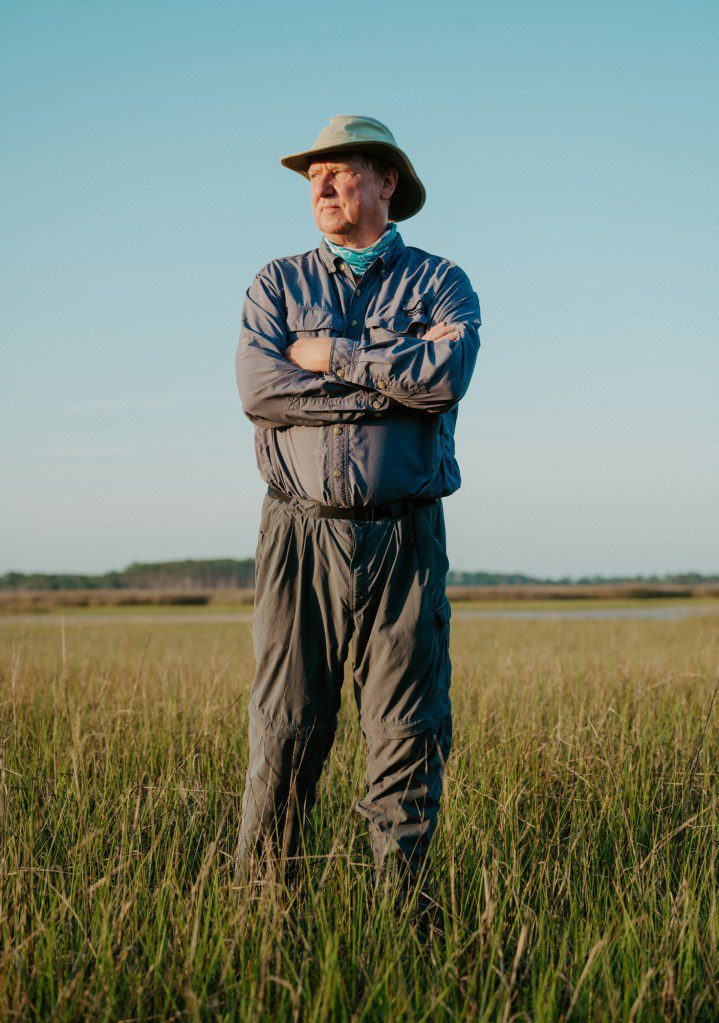
Scientist Thomas Van Lent worked for 17 years at the Everglades Foundation before quitting and then being sued by the organization.
Alicia Osborne Photography
The foundation always leaned Republican. Campaign contributions flowed from its founders and board to Republican candidates each cycle, although Jones once held fundraisers for President Barack Obama and often donated to both parties. But the foundation’s first president, a former senator, once stabbed a baby doll on the Senate floor to protest abortion and was described by a reporter as “willing to arm fetuses.” And as Michael Grunwald, the author of the 2006 book The Swamp: The Everglades, Florida, and the Politics of Paradise, says of the entire Everglades coalition, “It’s willing to anoint any politician who says nice things about the Everglades and pushed for funding as a champion of the Everglades.”
By 2018, things turned sour as the foundation, the state of Florida, and the National Academy of Sciences exchanged concerns about the reservoir meeting water quality standards with the available stormwater treatment areas. To eliminate doubts, the Florida Department of Environmental Protection signed a guarantee that the state would meet water quality standards once the reservoir came online. Eikenberg left that meeting relieved. In his mind, it was better than walking away with less than nothing. Van Lent left disappointed, believing it was just a means of delaying the issue. Cris Costello, the Sierra Club’s senior organizing manager, agreed that the guarantee was as good as the paper it was printed on. “That was the last straw,” Costello says. Soon after, there was another disagreement between the foundation and the Sierra Club about the use of state funding regarding restoration. Afterward, Costello says she got a call from the foundation’s COO, who warned, “You either agree with us, or we’re going to cut you off.” (The foundation’s former COO says that is “not a statement I would make in any context.”) But in 2019, the Sierra Club lost its annual grant funding from the foundation.
It was well-known that the foundation’s grants doubled as a means to whip votes on issues within the coalition, because any movement required unanimous agreement among dozens of members. “They used those groups to carry their message,” Van Lent says. Policy calls for grantees each week were allegedly mandatory, and when I asked Eikenberg, he said, “Messaging is important.”
In May 2021, the foundation appointed its former vice president of communications and engagement as chief science officer. The direction he issued to staff was “more messaging, less modeling,” according to Van Lent. That’s when he thought, “I can’t work here anymore.”
On Feb. 10, 2022, Van Lent resigned with an email. After 17 years as the organization’s top scientist, he was done. “My career at the foundation has been a source of personal pride, and I wish the Everglades Foundation continued success,” he wrote.
But on his last day two weeks later, he posted a tweet that recast his life. “Today marks my last day after nearly 17 years at the Everglades Foundation,” he wrote. “Will soon work with [the nonprofit Friends of the Everglades], who put facts over politics.” Van Lent was leaving the unparalleled nonprofit for a much smaller organization founded by author and Everglades activist Marjory Stoneman Douglas. Soon after, the board chairman at the time called Van Lent confused. He thought Van Lent was retiring, not taking another job. Then Van Lent said a threatening call followed from Paul Tudor Jones II, the foundations’ co-founder, as well as another board member in March. (Jones declined to comment.) A letter followed outlining the foundation’s request for Van Lent to return any files belonging to the foundation. “Without your complete cooperation, however,” it read, “the foundation will have no choice but to turn this matter over to outside litigation counsel.” Weeks passed as the foundation waited, claiming that Van Lent missed six deadlines to comply. The lawsuit came next, alleging that Van Lent disappeared with decades of data belonging to the foundation.
BY APRIL, THE FOUNDATION’S BOARD AGREED to file its lawsuit, retained lawyers, and submitted its complaint, alleging the destruction of thousands of files and accusing Van Lent of corporate espionage. Van Lent waved it off as a nuisance lawsuit, hiring an attorney who had helped him close on a condo in Tallahassee. He swore under oath that the only things he deleted from his computer were photographs, medical records, and personal emails. But in the foundation’s initial affidavit, it cited evidence from a forensic analyst it had hired, who showed that Van Lent deleted hundreds of thousands of files, not just from his laptop, but from shared servers that he managed at the foundation. Van Lent claims that he only deleted redundant files to carve out space. Another staffer confirms this was standard practice. But the foundation claimed he deleted memos, strategy documents, as well as other scientists’ work. Soon, the foundation and Van Lent reached a settlement before it collapsed.
Two days after the foundation filed its initial complaint, it requested an ex parte temporary injunction, an emergency court order meant to prevent Van Lent from destroying anymore of the foundation’s intellectual property. The language was broad enough that when the judge granted the injunction, it meant that Van Lent could violate it just by using any of his devices, including his cellphone. In May 2023, the court found that Van Lent committed indirect criminal contempt by continuing to delete files from his devices and “intentionally” violated the court’s temporary injunction, although Van Lent was never found liable for anything the foundation alleged in court.
After leaving the foundation’s office in South Miami, I drive up US 98, passing through the part of Florida that remains an uninterrupted line of springs, rivers, and forest to meet Van Lent in Tallahassee. He appears uneasy, almost somber, but when he starts to talk about the Everglades, his pupils narrow and his hands rise out of his lap to articulate each point of his story like a conductor.
The story Van Lent tells is how the nuances of the reservoir fell sway to the broader messaging of the foundation. Van Lent and other staffers didn’t think that the reservoir was bad, but that the foundation and the governor were overstating its benefits. By 2020, Van Lent believed that foundation members suspended their own doubts to nurture their growing influence with the DeSantis administration, even if it meant contradicting or ignoring their staff. “That’s why everyone left,” he says.

Rose Marie Cromwell
Six members of the foundation’s science wing left between 2021 and 2022. After DeSantis’ election, the relationship between Eikenberg and Van Lent metastasized, creating a noxious atmosphere for the science team. By January 2021, the exodus began with the team’s director, followed by the termination of its ecological economist, who studied the monetary impact of natural resources. Then its senior hydrologist left. Van Lent resigned next. The foundation’s water-quality scientist and environmental engineer followed two months later.
That year, the foundation’s revenue exceeded $28 million, and Eikenberg’s salary was more than $400,000. Under his leadership, dozens of lobbyists joined the fray, an education wing formed, and annual revenue grew significantly. Leaders claimed science remained the foundation’s core mission. As Jones told Amy Green for her 2021 book, Moving Water, “So much of the state and federal policy has been driven by our scientists because they know we are 100 percent committed to scientific truth and nothing else.”
But internally, even its own scientists questioned the commitment. One former member of the team was told that a study they produced for the foundation didn’t align with the case it hoped to make to legislators. The former staffer was told that the leadership was “unhappy with the numbers.” A month later, they were fired. (The foundation denies asking any staff to change conclusions in any report.)
Former foundation staffers were reluctant to talk with me, fearful of how it might affect their careers, future dealings with the foundation, and how the organization might respond in light of its lawsuit against Van Lent. Those who did speak with me under the condition of anonymity confirmed that all of their work, whether it was modeling, PowerPoints, or data was shared openly. They say that they took their work with them when they left, and some saw the lawsuit against Van Lent as an attempt to either humiliate him, destroy his reputation, or diminish his influence. Van Lent declared bankruptcy after the court forced him to pay $178,000 for the foundation’s legal fees. “For the first time in my life, I’ve had anxiety attacks,” he tells me. “You feel like your whole career, your whole life was a waste. Seventeen years with the Everglades Foundation, and it all went up in smoke.”
ANOTHER MORNING IN JULY, I pass through a strand of heavy rain along the edge of Shark Valley. Just before I arrive at the dock on the Miccosukee reservation, the sky returns to blue. I step onto an airboat with Eric Eikenberg, the foundation’s VP of communications, its chief science officer, and our guide.
When I ask what really happened with Van Lent, Eikenberg bristles but then leads me through his side of things. “From our perspective,” he says, “we got everything we had wanted. Reservoir, approved.” That’s when it soured with Van Lent. “All I know, his attitude, his persona, how he carried himself was completely different than what I had ever seen before.” Still, Van Lent continued to lead the science wing and participate in board meetings. “The leadership style or the path we were going down was open to anybody,” Eikenberg says. “The direction in which we were going was not one individual going rogue.”
After Van Lent joined the Friends of the Everglades in April 2022, the much smaller but historically important nonprofit, the foundation accused him of destroying its intellectual property, including what Eikenberg claimed was “multiple other scientists’ work,” due to his administrative privileges over two of the three servers containing the foundation’s intellectual property. Soon after, the foundation hired a third party to oversee its digital architecture.
According to Eikenberg, the foundation lost the entirety of Van Lent’s 17 years of research, two other employees’ libraries, including memos, presentations, and hydrological models. “It was determined that he had left us no other choice,” Eikenberg says. “And the board ultimately, the organization made the decision. That’s the property of the Everglades Foundation. That’s the organization’s work that’s funded by the generosity of its donors.” A pause comes, and Eikenberg asks the guide to take the long way back home as we watch the Everglades pass by in a torrent of green and silver.
Twenty minutes later at the dock, Eikenberg adds, “It’s made us stronger.” I ask if he meant the litigation or something else. “Going through it,” he says. “We’ve been able to bring on and establish a tremendous science team. The foundation continues to do its mission-driven work, and it’s made us stronger.”
It’s true that without the Everglades Foundation, the restoration of this unparalleled ecosystem might still be collecting dust in technical papers and hearing committees. The foundation and its supporters have played the long game, nurturing longstanding relationships with whatever governor or president was in office, sometimes to the dismay of its critics. It has drawn funding from every administration, kicked and screamed until spades tore into the earth, and carved a path for water to return in some form.
I ask Eikenberg if he thought the Everglades would reach a point of restoration in his lifetime that he’d be happy with. “There’s no doubt in my mind,” he says. “You cannot afford to lose it.” As for the legal odyssey that followed Van Lent’s resignation, Eikenberg tells me, “It’s a sad affair that took place. It could have been avoided. And in fact, we attempted to end it.”
A YEAR LATER, ON JULY 27, Van Lent waited to hear his name called in jail. Once they called him, he shed his jumpsuit, walked outside, and reunited with his wife. They drove back to Tallahassee that day, traversing his beloved Everglades along the Tamiami Trail, and his mind ran through the saga of the past few years. He found nothing redemptive about that 10-day nightmare in a cell, but when he left, he felt his commitment to the Everglades, to science, and to truth was galvanized. “I will continue to speak up,” he says, “to tell the truth.”
This article is supported by the Economic Hardship Reporting Project.