
How NIN’s Robin Finck Designed the ‘Psychedelic’ Soundscape of Horror Game ‘Sleep Awake’
Whether it’s a movie or a game, a good horror experience is almost entirely driven by sound. Audiences react to jump scares, body horror, and skin-crawling nightmarish imagery, but all work in tandem with audio — or the intentional lack thereof — to drive home discomfort. Just as much as viewers can recall a particularly gruesome visual or haunting scene, they inherently play back in their heads the squelches, footsteps, whispers, and sonic booms that triggered their fight or flight.
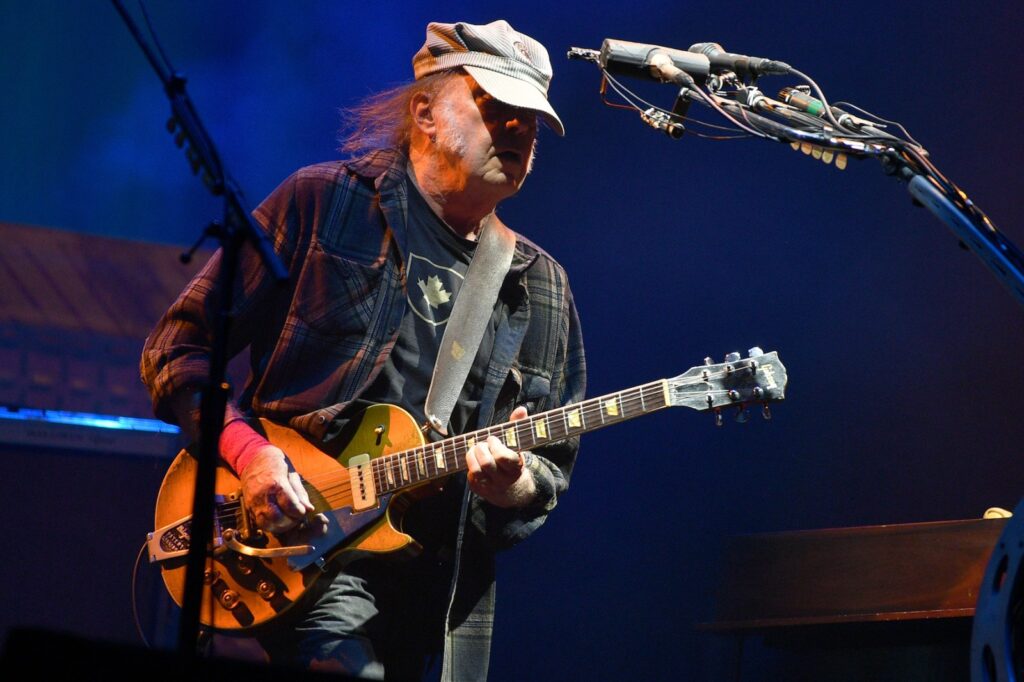
Few know the alchemy of unsettling audio design better than Nine Inch Nails and one-time Guns n’ Roses guitarist Robin Finck, who toured with NIN from 1994 to 2000, and returned for their subsequent road shows from 2013 to the present. Over the last decade, Finck has also been delving into the world of game development, experimenting with soundscapes and audiovisual design alongside his friend and business partner, veteran game dev Cory Davis (Spec Ops: The Line).
Together, the duo co-founded their own arthouse indie game studio, Eyes Out, in 2019, and has just launched their first title, the psychedelic horror title Sleep Awake — a first-person nightmare heavily informed by music and soundscape. Speaking with Rolling Stone, Finck describes the game, on which he serves as both co-creative director and composer, as exploring “the realm between sleep and death.”
Sleep Awake is set 300 years in the future in the last known city on Earth, called the Crush, drifting between the crumbling urban ruins as well as a symbolic otherworldly realm referred to as the Fathom. In this fractured reality, a phenomenon known as the Hush has taken root, and anyone who falls asleep disappears forever. Players embody a young woman named Katja, whose family fell victim to the Hush, and is desperately trying to survive day-to-day as the psychosis of sleep depravation make real life indistinguishable from dreams.
Work on the game officially began back in 2020, as Eyes Out was staffing up a team of 20 developers just as the pandemic hit. But its true origins run further back roughly 10 years to Burning Man (as many great odysseys do), where Finck first met Mike Wilson, co-founder of indie publisher Devolver Digital, kicking off what the musician describes as “an unlikely path of discovery.”
“[Mike casually] asked me if I’d be interested in providing score for a game that Devolver was developing,” Finck says. “My knee jerk reaction was to tell him, ‘[I] really don’t know about video games. I didn’t grow up playing video games, so surely you want to ask somebody else.’ And I hung up the phone and felt terrible for having said no because I saw pretty quickly that, subconsciously, I lacked the confidence. I was afraid I was going to toe into someone else’s experience and muck it up for them. I immediately called him back and reversed that no to a yes.”
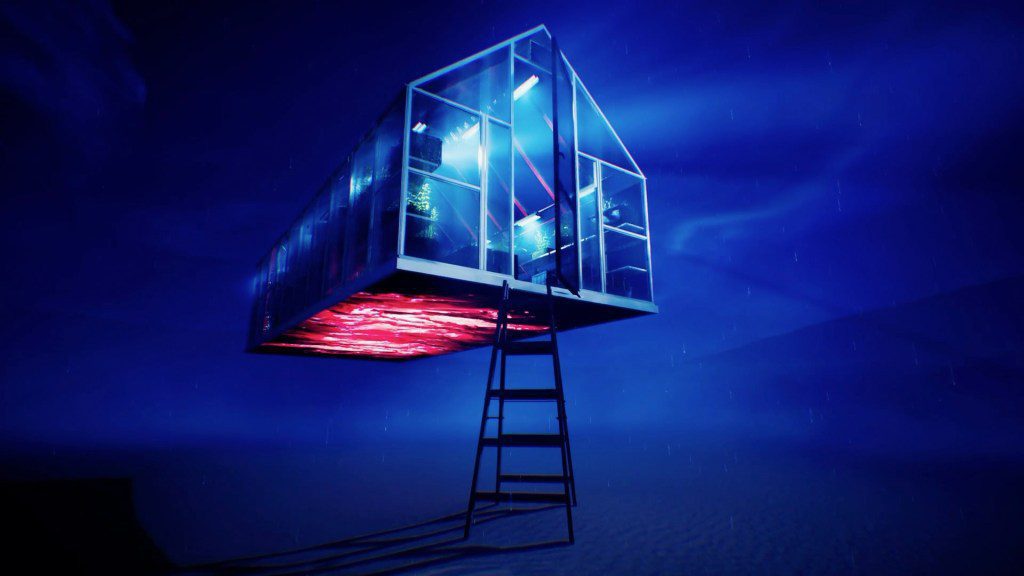
In the Fathom, dreams and reality become indecipherable.
Blumhouse Games
Working with Wilson, Finck immersed himself in the culture and business of game development, traveling to conferences where he met his now-partner, Davis, who invited him to Sony’s Santa Monica Studio to preview a VR horror game called Here They Lie. From there, the two bonded over their shared passion for music.
“In the beginning, it was us working on music together, soundscape, photo bashing in art, environments, character design, gameplay ideas,” Finck says. “Then we happened upon a few hooks that were stringing this narrative arc. Then, Sleep Awake didn’t have a name, but we were inspired and we were really at it together, day in and day out, for a solid year before we started pitching a short playable prototype.”
The concepts behind Sleep Awake were fully formed during a reclusive getaway to Joshua Tree, where Finck and Davis loaded up “two van loads of gear and a house off the grid,” where they “just let it rip and improvised.” Finck describes the Joshua Tree sessions as being “the portal” through which this story and world emerged from, leading to a “hot shit pitch deck” that was used to garner funding, as well as the creative bible that the developers would reference moving forward.
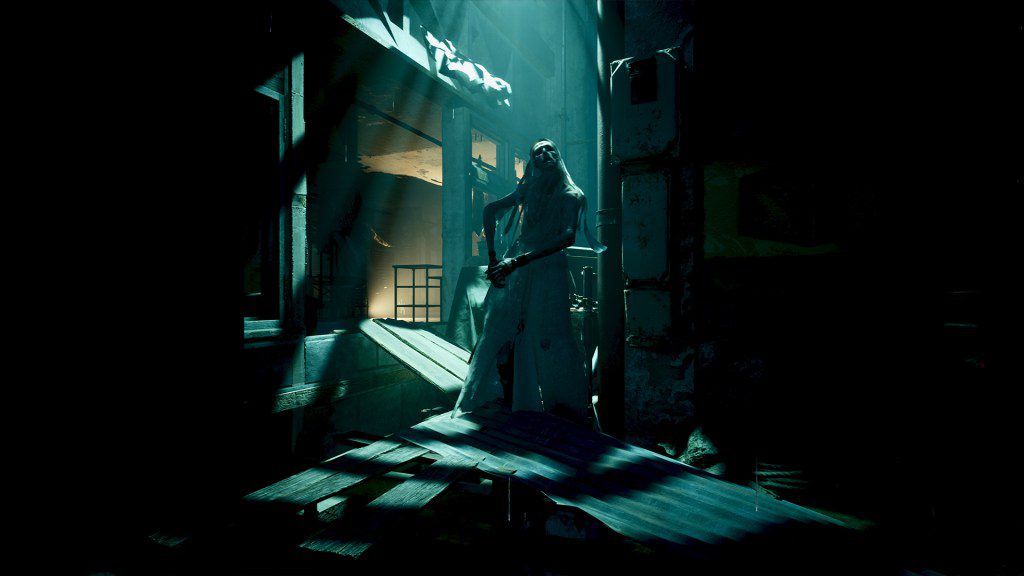
Sleep Awake is a first-person horror survival game filled with haunting visuals and soundscapes.
Blumhouse Games
“Once upon a time, I did have a carefully thought-out wireframe and audio design doc that was well organized towards success; towards the hypnotic, ominous, psychedelic, evil score and soundscape for this narrative experience,” Finck says. “And I did dress different characters and environments and gameplay sequences with specific instrumentation on paper for that vision. I made some choices from a distance about what I’m going to explore and, more decidedly, what I’m not going to explore.”
The ongoing development of Sleep Awake was an intensively collaborative effort where Finck was challenged to not just imagine tangible elements of the game world — or even just make great music for it — but to take his own improvisational work to marry with the ideas from the team’s recurring virtual meetings into something cohesive.
“We would host a bi-weekly show-and-tell on Discord where everyone would go around the horn and [share] what they’re into, what they’ve been working on, challenging they’re facing and victory stuff they’re excited about,” Finck recalls. “Sometimes it would be Thursday night and I’d be like, ‘Holy shit, tomorrow’s show and tell and I’ve got nothing.’ [I] may have crammed something together in homeroom.”
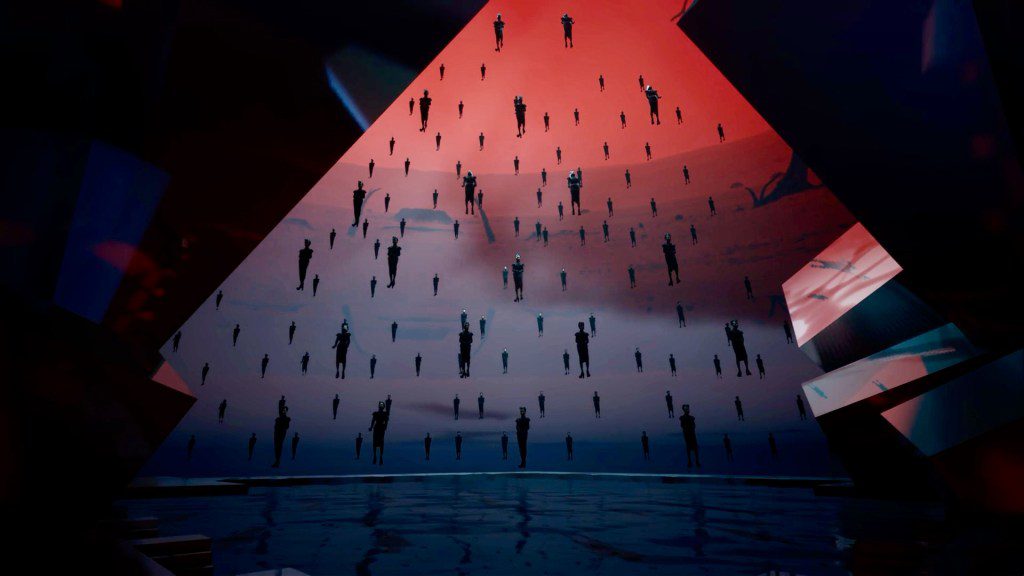
Hallucinations creep into the game world augmented by full-motion video sequences.
Blumhouse Games
Finck acknowledges the learning curve of designing music for a game often boiled down to understanding its intent and implementation necessitated by the medium’s interactive elements. Just because a piece of music is good doesn’t mean it’ll fit the elasticity of every player’s experience.
“Some of the challenges for me were deviating from song structure. Sometimes I would get inspired and go all night and listen back the next day, and still be interested in the music, but really having to squint to lay it, implement, [or] to visualize it within the gameplay experience,” Finck admits. “Sometimes, a great piece of music that I love just wouldn’t work; it just took us out of the immersion, and that was never going to make it. I’ve never worked at such a length, with vertical stacks of looping game cues and relying on the engine, or really, the player experience — [because] here’s so many different play styles to be preparing for.”
Sleep Awake is primarily a stealth and puzzle game, where players are tasked to creep their way through corridors and alleys, attempting to stay out of sight from disfigured cultists, who have mutilated their bodies in the delirium of their trancelike existence, as well as violent fascist soldiers of the Delta Transit Ministry (DTM for short).
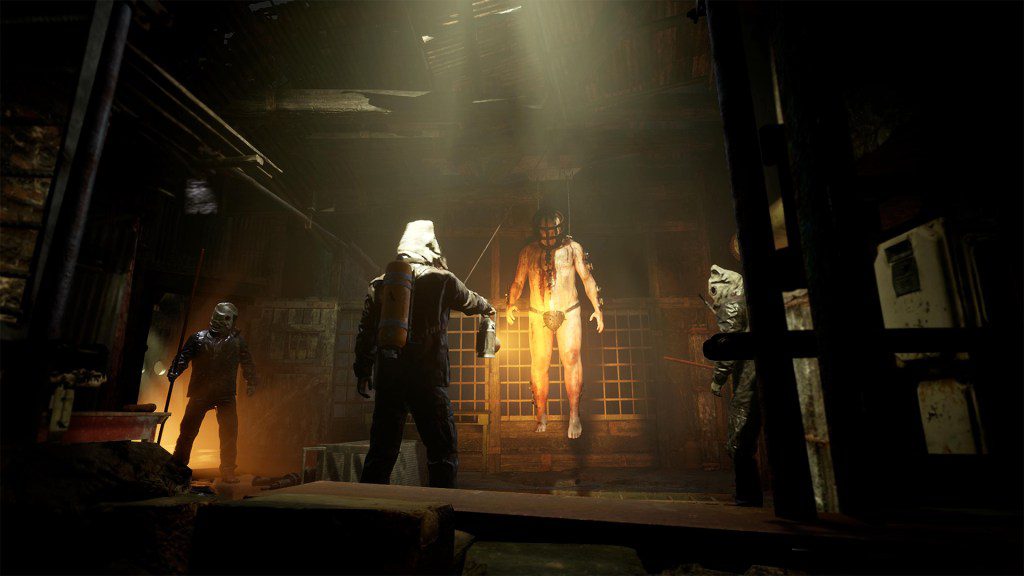
Cultists and the DTM alike are invasive threats to each other and the player.
Blumhouse Games
Its visuals are unnerving, to say the least. Peeking through shattered windows and cracks in the walls, Katja witnesses cultists driving metal spikes into their flesh and hanging themselves from hooks like the Cenobites from Hellraiser in an attempt to drive away the allure of sleep with unadulterated pain. The DTM responds to the crisis as fascists do, with a steel-toed boot and baton beating and ruthless executions.
In between the stomach-churning physical violence, players are also constantly dipping into hallucinations and time displacement that’s wildly disorienting. One minute, you’ll be sprinting from an assailant in a blood-soaked torture chamber only to end up 10 or 20 feet back from where you started, with full-motion video (FMV) clips bleed into the in-engine imagery in ways that evoke many Nine Inch Nails music videos.
Finck notes that there might be similarities between those famous NIN videos and Sleep Awake, the overlap is not intentional. “There was no conscious sisterly string [or] play towards a Nine Inch Nails bent or anything like that. This is a dark, heady experience, and I guess, in that, there is some commonality.”
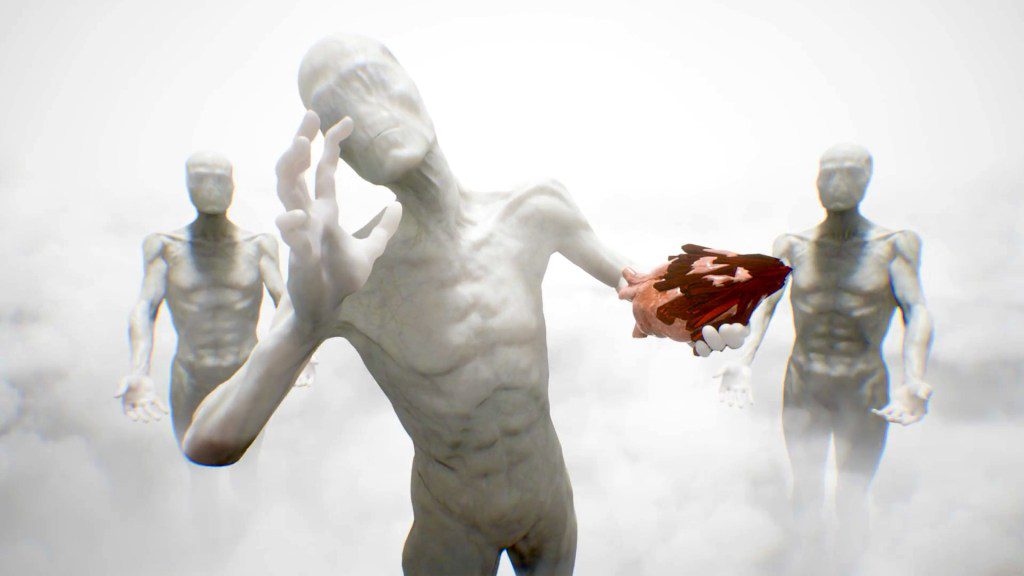
As sleep depravation takes hold, the biorhythms of humans invite the Hush.
Blumhouse Games
Amid the involuntary hallucinations and gnawing body horror of the Crush, the soundscapes designed by Finck weave throughout the entire experience, soaking into player’s minds with somber hums and synthetic loops — often punctuated by harsh percussion that startles Katja (and the player) out of the near-sleep lulls. Inching on their knees, crouched beneath a table as murderers scout for Katja, audiences will find that footsteps, heaving breathing, the clanking of blades and chains will be their only tells for when it’s safe to progress.
“Sound can be pivotal in the creation of moments of fear and dread, [and] the absence of sound, creating a void or a chasm between two soundscapes can be unbearable,” Finck says. “Sometimes that’s we’re aiming at because [then] the other side of that chasm is amplified tenfold.”
Sound and music don’t just play a literal role in the game’s score but are organically implemented within Sleep Awake’s world. In her flat, Katja performs rituals with liquids and sound waves to ingredients for serums that she applies into her eyes to fend off drowsiness. Out in the Crush, she’ll find Void Shadows — physical outlines of disappeared people that resemble the shadows of Hiroshima — to which she vocally harmonizes to see their spirits.
The Hush itself is drawn to the frequencies of humankind, making sound an integral part of the game’s lore. “Since its inception, we’ve been playing with the idea of biorhythms being emitted from those who enter deep delta state, who are [near] sleep. And when they’re in this delta state, they emit these biorhythms that are then detected by ethereal beings from outside the city — these are the Sadists of the Hush,” Finck explains. “We’re playing with frequency and the unseen and cymatics, the disturbance of matter [that] organizes around frequency. And so, frequency and sound is inherent in the genesis of the storied worldbuilding.”
Paired with the visual trickery of the hallucinations, the horrors of Sleep Awake often resemble sleep paralysis. You can hear the writhing pulse of the world and the terrors that lurk well before they ever really appear. “We play with sound as it pricks our imaginations about what is unseen,” Finck says. “[It’s] inferred by the developers, but really, we’re providing opportunity for the player to wonder or surmise, and I love seeding an event with audio before it’s visual, before it’s made seen to the player or audience. We experimented with the difference between diegetic sound as it plays in [sync] with the underscore.”
As a first foray in game development for Finck, Sleep Awake is a hell of freshman effort. To solve its puzzles and, most importantly, stay alive, players will need to pay close attention to their surroundings. This isn’t something to be experienced half-heartedly while staring at your phone.
Finck advises that the best way to play is to completely lock in for immersion: “[You need] lights out, headphones on, volume up, some time — [and] more than anything, intention of letting go and diving in [to] follow this journey through the rabbit hole.”
Sleep Awake is available for PS5, Xbox Series X|S, and PC. Its soundtrack is now streaming.